July
〰️
July 〰️
The July Day in History Series brings together a wide range of people, events, conflicts, discoveries, and civic turning points that help students see history as an active story of choices, challenges, and change. Across the month, students encounter the American Revolution, the Declaration of Independence, constitutional debates, westward expansion, civil rights, women’s rights, scientific discovery, space exploration, military service, public leadership, innovation, and social reform.
These events are important in the study of history because they show how individuals and communities respond to problems, defend ideals, question injustice, create new systems, and shape the future. Through project-based learning, students move beyond memorizing dates and names; they investigate causes and consequences, compare perspectives, create timelines and exhibits, analyze documents, and connect past events to questions that still matter today. History becomes a way to understand citizenship, courage, responsibility, creativity, and the ongoing work of building a more informed and thoughtful society.
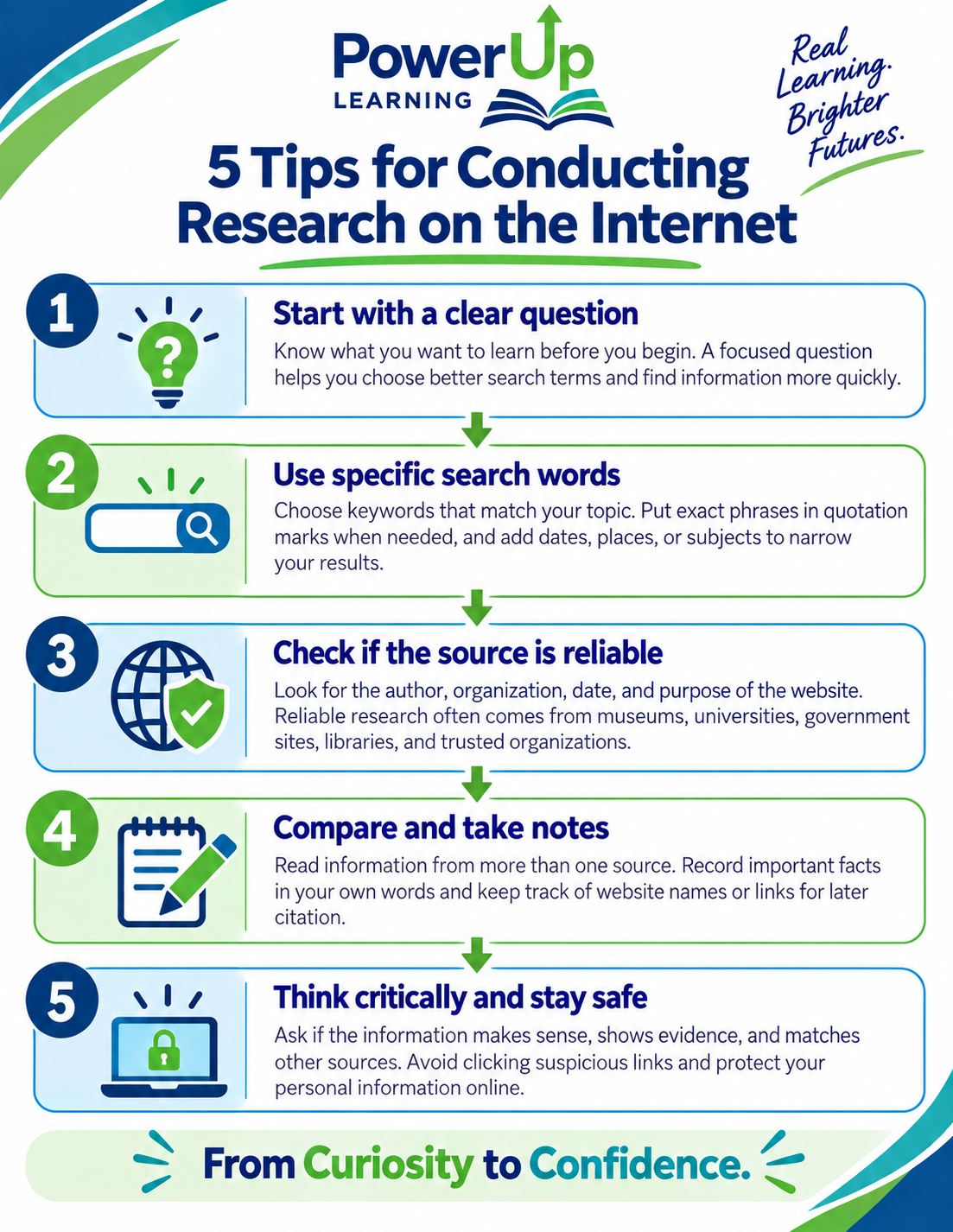
This Learning Tips diagram explains a simple five-step process learners can follow when conducting research on the Internet. It begins by encouraging learners to start with a clear question so they know what they are trying to learn before they search. Then it reminds them to use specific search words, check whether a source is reliable, compare information from more than one source, and take careful notes.
The final step asks students to think critically and stay safe by questioning whether information makes sense, looking for evidence, avoiding suspicious links, and protecting personal information online. Overall, these Learning Tips help learners understand that Internet research is not just about finding information quickly; it is about finding trustworthy information, organizing it responsibly, and using it thoughtfully.