May 23: Margaret Fuller
Margaret Fuller (1810 - 1850) was born in Massachusetts.
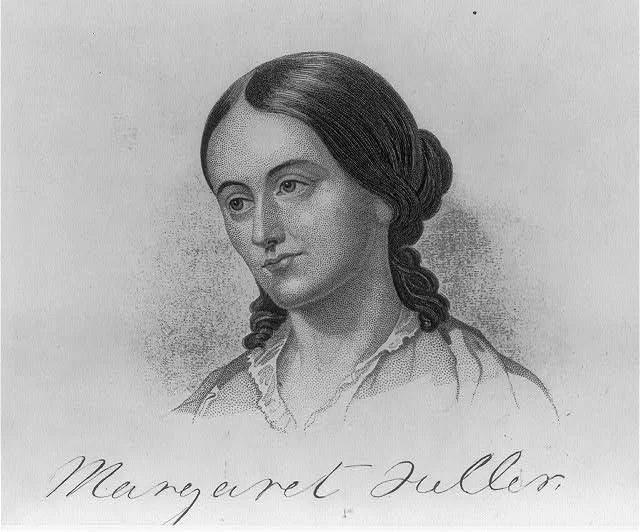
Margaret Fuller became an influential American teacher, writer, editor, journalist, and advocate for women’s rights. She argued that women deserved serious educational opportunities at a time when higher education was largely closed to them. She also led “Conversations,” organized discussions for women in Boston to share their ideas on women’s rights in society. Her writings and advocacy significantly influenced the work of the Seneca Falls Women’s Rights gathering in 1848. Fuller’s 1845 book, Woman in the Nineteenth Century, became an important early work in the history of women’s rights and helped shape later conversations about women’s education, employment, and public participation. She wrote, “We would have every arbitrary barrier thrown down. We would have every path laid open to woman as freely as to man….then and then only will mankind be ripe for this, when inward and outward freedom for woman as much as for man shall be acknowledged as a right, not yielded as a concession.” Image: Library of Congress (https://www.womenofthehall.org/inductee/margaret-fuller/)
Student Projects
Critical thinking question: How did Margaret Fuller’s work challenge the limited educational opportunities available to women in the 1800s?
1. Women’s Education Then and Now
Project Goal:
Students will examine how educational opportunities for women in the 1800s differed from educational opportunities today.
Project Description:
Margaret Fuller believed that women deserved serious intellectual development, not just basic instruction in manners, domestic skills, or social expectations. In this project, students research what education was commonly available to girls and women in the early 1800s and compare it with educational opportunities available to women today.
Research Questions:
What subjects were girls encouraged to study in the 1800s?
What subjects were often considered “inappropriate” or unnecessary for women?
How did limited education affect women’s choices in work, writing, leadership, and public life?
What educational opportunities do women have today that were not widely available in Fuller’s time?
Final Product Options:
Students may create a comparison chart, poster, slideshow, illustrated timeline, or short written report.
Reflection Question:
Why does access to education affect a person’s ability to participate fully in society?
2. Margaret Fuller “Conversations” Discussion Circle
Project Goal:
Students will understand how Margaret Fuller used discussion as a tool for learning, leadership, and social change.
Project Description:
Margaret Fuller hosted intellectual discussion groups known as “Conversations,” where women gathered to discuss literature, philosophy, education, rights, and society. In this project, students recreate a discussion circle based on one of the major issues Fuller cared about. The goal is not simply to debate, but to practice thoughtful listening, respectful questioning, and evidence-based discussion.
Suggested Discussion Topics:
Should education prepare people only for work, or also for leadership and personal growth?
Why were women’s voices often excluded from public life in the 1800s?
How does society benefit when more people have access to education?
What responsibilities come with having a public voice?
Final Product Options:
Students may hold a family discussion, record a short podcast-style conversation, create discussion cards, write a group reflection, or produce a one-page summary of the strongest ideas shared.
Reflection Question:
How can conversation become a form of education and social reform?
3. Public Voice and Reform Writing Project
Project Goal:
Students will explore how writing can be used to challenge unfair ideas and promote social change.
Project Description:
Margaret Fuller used writing to question the limited roles assigned to women and to argue that women deserved intellectual, professional, and personal freedom. In this project, students choose one issue connected to Fuller’s work and write a persuasive piece that explains why the issue matters.
Possible Topics:
Women’s access to higher education
The importance of reading and intellectual independence
Equal opportunity in leadership
The right to speak, write, and publish ideas
How education helps people challenge unfair expectations
Final Product Options:
Students may write an editorial, letter to the editor, persuasive essay, speech, blog post, or illustrated opinion page.
Reflection Question:
How can one person’s writing influence the way society thinks about education, equality, and opportunity?
4. Design your own project on the Seneca Falls Women’s Rights gathering in 1848.
Here is a source to get you started: https://www.massmoments.org/moment-details/writer-margaret-fuller-born.html