June 12: Babe Ruth and the Day Baseball Built Its Hall of Fame

Babe Ruth in 1919, before becoming one of the most famous power hitters in baseball history.
On June 12, 1939, the National Baseball Hall of Fame held its first formal induction ceremony in Cooperstown, New York. The event brought together some of the most famous names in baseball history, including Babe Ruth, Ty Cobb, Honus Wagner, Walter Johnson, Cy Young, Connie Mack, Eddie Collins, George Sisler, Tris Speaker, Grover Cleveland Alexander, and Napoleon Lajoie. The Hall of Fame notes that the first induction ceremony was held on June 12, 1939, with all 11 living baseball players inducted into the Hall of Fame present in Cooperstown.
Babe Ruth was born George Herman Ruth Jr. on February 6, 1895, in Baltimore, Maryland. As a child, he was sent to St. Mary’s Industrial School for Boys, where he learned to play baseball and developed the skills that would shape his future. His talent was recognized early, and he began his professional career as a pitcher. Ruth first gained major attention with the Boston Red Sox, where he became one of the best left-handed pitchers in baseball and helped the team win World Series championships.
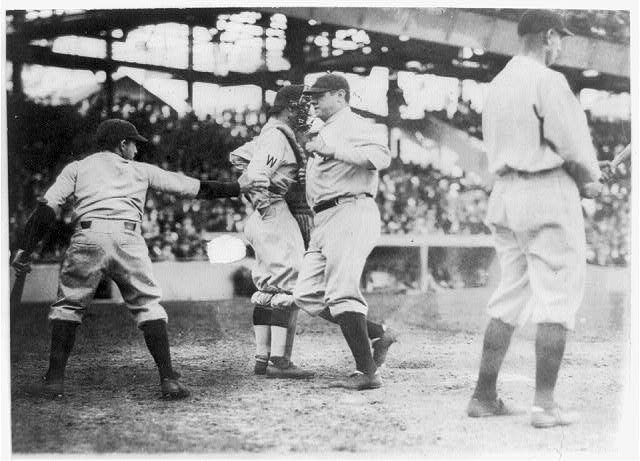
Babe Ruth crossing the plate after making his first home run of the season, 1924| Library of Congress
Ruth’s career changed dramatically when he became known not just as a pitcher, but as a powerful hitter. After he was sold to the New York Yankees in 1919, he transformed the game of baseball. At a time when baseball had often focused on bunts, base running, and low-scoring strategy, Ruth brought a new excitement to the sport through home runs. His strength, confidence, and dramatic style helped launch the “live-ball era” and made the home run one of baseball’s most thrilling plays. With the Yankees, he became a national celebrity and helped turn the team into one of the most famous franchises in sports history.
By the end of his career, Babe Ruth had become more than a baseball player. He was one of the first true American sports icons, known for his records, personality, and larger-than-life public image. He finished his career with 714 home runs, a record that stood for decades. He died on August 16, 1948, but his legacy continues because he changed how baseball was played, watched, and remembered.Discovery Projects
Project 1: Babe Ruth Biography Profile
Focus: Reading, Writing, Art
Project Goal:
Students will explain why Babe Ruth became one of the most famous athletes in American history.
Project Description:
Students will research Babe Ruth’s life and career, including his early years, his time as a pitcher, his shift to power hitting, his years with the New York Yankees, and his role in the first Hall of Fame ceremony. Students should explain how Ruth changed baseball and why his fame extended beyond the sport.
Final Project Options:
Students may create a biography poster, sports-card profile, illustrated timeline, short research essay, podcast episode, or museum exhibit panel.
Reflection Question:
Why do some athletes become cultural symbols as well as sports figures?
Project 2: Build a Baseball Hall of Fame Exhibit
Focus: History, Technology, Art
Project Goal:
Students will understand how museums choose, organize, and explain important people and events.
Project Description:
Students will design a mini museum exhibit about the first Baseball Hall of Fame induction ceremony. The exhibit should include key players, artifacts, photographs, short captions, a timeline, and an explanation of why Cooperstown became central to baseball memory.
Final Project Options:
Students may create a trifold exhibit board, digital museum gallery, artifact display, slideshow, or guided exhibit script.
Reflection Question:
How does a museum shape the way people remember the past?
Project 3: Baseball by the Numbers
Focus: Math, History
Project Goal:
Students will use statistics to understand why early Hall of Fame players were considered legendary.
Project Description:
Students will choose several 1939 Hall of Fame inductees and compare their baseball statistics. They may examine home runs, batting average, pitching wins, earned run average, stolen bases, games played, or other measures. Students should also consider what statistics can and cannot tell us about greatness.
Final Project Options:
Students may create a data chart, infographic, player comparison table, math-based slideshow, or “Who belongs in the Hall?” argument poster.
Reflection Question:
Can numbers fully explain why someone belongs in a Hall of Fame?
Project 4: The Myth of Cooperstown
Focus: History, Geography, Writing
Project Goal:
Students will investigate the story that baseball was invented in Cooperstown and evaluate why origin stories matter.
Project Description:
Students will research the claim that Abner Doubleday invented baseball in Cooperstown and compare it with historians’ understanding that baseball developed from older bat-and-ball games. Students will explain how myths can become powerful even when historical evidence is weak.
Final Project Options:
Students may create a myth-versus-history chart, investigative report, origin story poster, short documentary script, or classroom debate.
Reflection Question:
Why do communities sometimes create or preserve stories about where something began?
Project 5: Create Your Own Hall of Fame
Focus: History, Literature, Art
Project Goal:
Students will evaluate what qualities make a person worthy of lasting public recognition.
Project Description:
Students will create a Hall of Fame for a topic they care about, such as local history, science, literature, music, civil rights, inventions, sports, or family history. They must choose criteria for selection, nominate several people, defend their choices with evidence, and design a display explaining each honoree’s contribution.
Final Project Options:
Students may create a classroom Hall of Fame wall, digital gallery, nomination packet, award ceremony script, poster series, or presentation.
Reflection Question:
What should people be remembered for: talent, impact, character, courage, innovation, or popularity?