Jacques-Yves Cousteau, ocean explorer, filmmaker, inventor, and conservationist. | NASA
Jacques-Yves Cousteau was born on June 11, 1910, in France and became one of the most famous ocean explorers of the twentieth century. As a young man, he served in the French navy and developed a deep interest in the sea, photography, and underwater exploration. After a serious automobile accident ended some of his early ambitions, Cousteau turned even more fully toward the ocean. His curiosity led him to experiment with underwater filming and diving equipment at a time when much of the underwater world was still difficult for people to reach and study.
One of Cousteau’s most important achievements was helping to develop the Aqua-Lung with engineer Émile Gagnan in the 1940s. This invention made it possible for divers to breathe underwater more freely and helped open the way for modern scuba diving. Cousteau later acquired the research vessel Calypso, which became the center of his ocean expeditions. Through books, films, and television programs, he brought images of coral reefs, shipwrecks, marine animals, and underwater ecosystems into homes and classrooms around the world. His documentaries helped people see the ocean as a living world full of beauty, danger, and scientific importance.
Later in life, Cousteau became increasingly focused on marine conservation. He warned that pollution, overfishing, and careless human activity were damaging the oceans. His work helped inspire public interest in protecting marine life and studying ocean environments more responsibly. Cousteau died on June 25, 1997, but his legacy continues through ocean science, scuba diving, documentary filmmaking, and environmental education. He remains important because he helped millions of people understand that the ocean is not distant or empty; it is essential to life on Earth and worthy of protection.
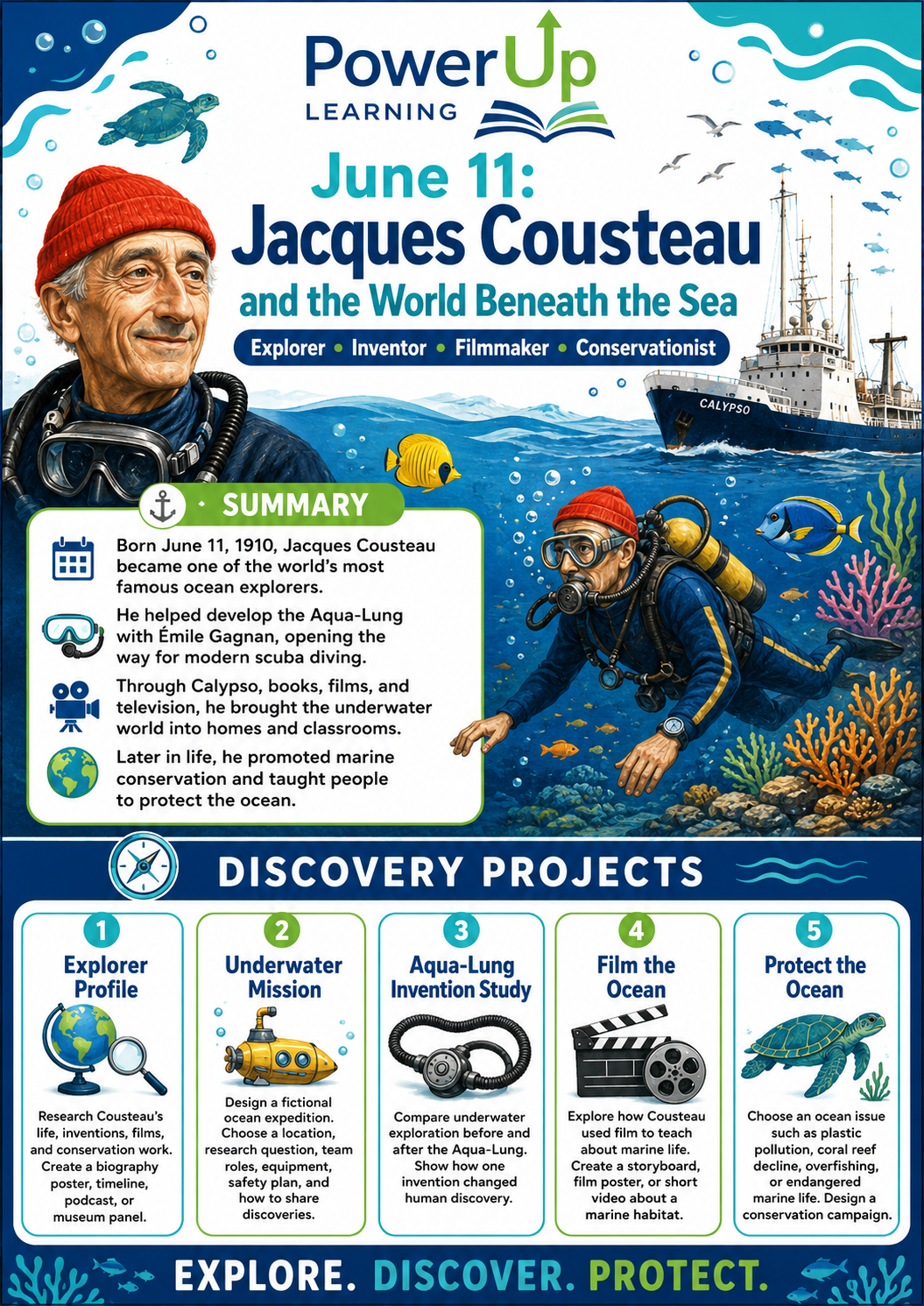
Discovery Projects
Project 1: Jacques Cousteau Explorer Profile
Project Goal:
Students will explain who Jacques Cousteau was and why his work changed ocean exploration.
Project Description:
Students will research Cousteau’s life, including his early interest in the sea, his work as a naval officer, his role in developing underwater breathing technology, his films, and his conservation work. Students should explain why Cousteau became one of the most recognizable ocean explorers of the twentieth century.
Final Project Options:
Students may create a biography poster, explorer profile, illustrated timeline, podcast episode, short research essay, or museum-style exhibit panel.
Reflection Question:
How can one person’s curiosity help change what the world understands about nature?
Project 2: Design an Underwater Exploration Mission
Project Goal:
Students will understand the planning needed for ocean exploration.
Project Description:
Students will design a fictional underwater research mission inspired by Cousteau’s work. They must choose a location, research question, team roles, equipment, safety plan, and method for sharing discoveries with the public.
Final Project Options:
Students may create a mission proposal, expedition map, research vessel plan, safety checklist, slideshow, or documentary pitch.
Reflection Question:
What makes underwater exploration both exciting and dangerous?
Project 3: Aqua-Lung and Invention Study
Project Goal:
Students will examine how the Aqua-Lung changed the way humans explored underwater environments.
Project Description:
Students will compare underwater exploration before and after the Aqua-Lung. They should research older diving methods, the limits of surface-supplied diving equipment, and how self-contained breathing equipment gave divers more movement and independence.
Final Project Options:
Students may create an invention diagram, then-and-now comparison chart, engineering poster, short explanatory video, or “how it changed exploration” infographic.
Reflection Question:
How can one invention open an entirely new world for human discovery?
Project 4: Film the Ocean — Science Communication Project
Project Goal:
Students will analyze how Cousteau used television and YouTube to teach people about the ocean.
Project Description:
Students will research how Cousteau brought underwater images to public audiences. They should explain why seeing ocean life on film was powerful and how documentaries can help people care about places they may never visit.
Final Project Options:
Students may create a documentary storyboard, narration script, film poster, public education campaign, or short video explaining a marine habitat.
Reflection Question:
Why do images and films sometimes teach people more powerfully than written descriptions alone?
Project 5: Protect the Ocean Campaign
Project Goal:
Students will connect Cousteau’s exploration legacy to modern ocean conservation.
Project Description:
Students will choose one ocean issue, such as plastic pollution, coral reef decline, overfishing, deep-sea mining, endangered marine animals, or climate effects on oceans. They will research the problem and design a student-friendly conservation campaign.
Final Project Options:
Students may create an infographic, poster campaign, public service announcement, digital slide deck, short speech, or classroom action plan.
Reflection Question:
How does learning about the ocean create responsibility for protecting it?