“There is a flock of yellow birds around her head.” Painting of two alleged witches being tried in Salem, Massachusetts. Oil on canvas board en grisaille.Howard Pyle 1892 | publc domain
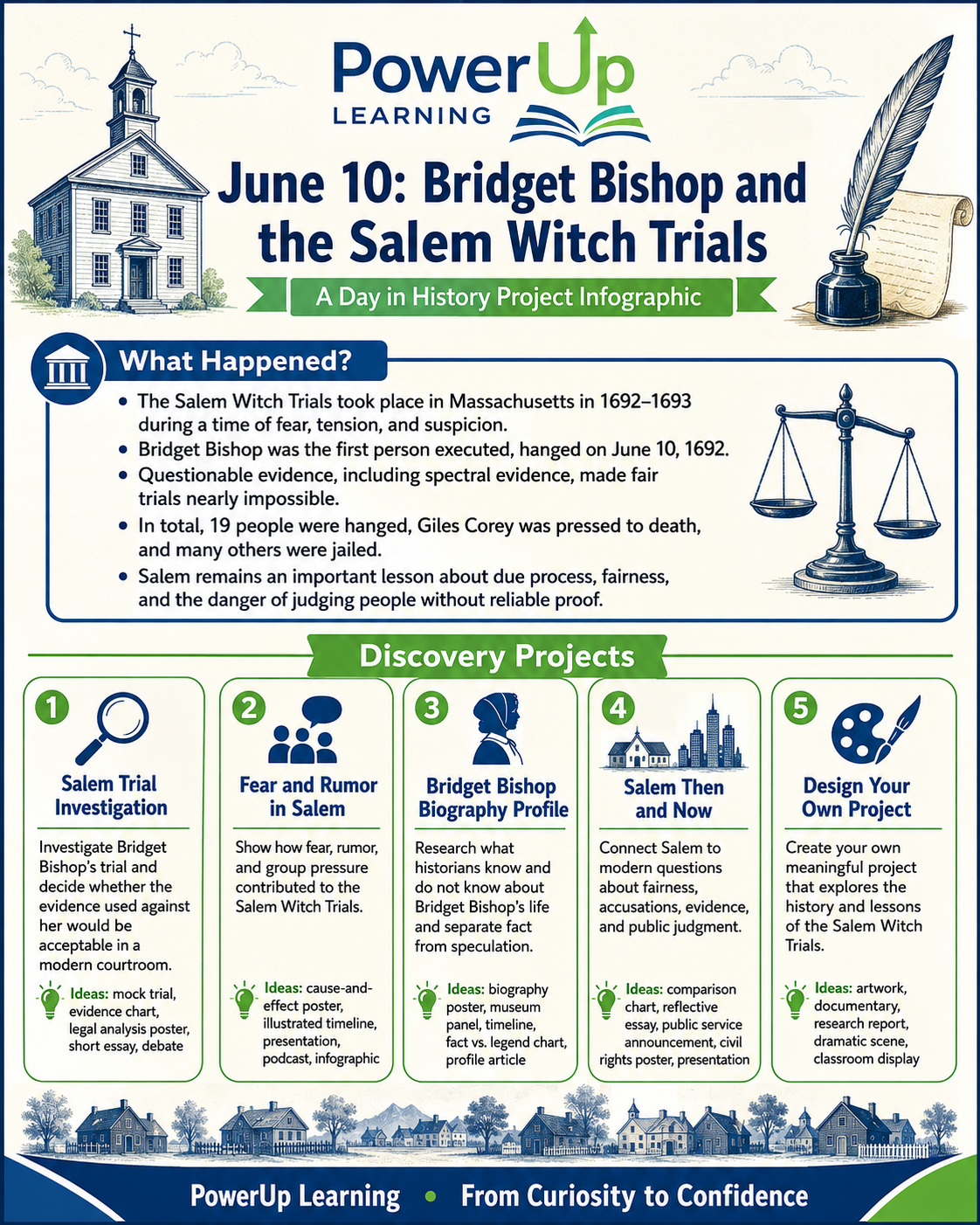
On June 10, 1692, Bridget Bishop became the first person executed during the Salem Witch Trials in Massachusetts. She had been accused of witchcraft during a period of fear and suspicion in Salem Village and Salem Town. The Salem Witch Trials took place in colonial Massachusetts in 1692 and 1693, during a time of fear, religious tension, political uncertainty, and community conflict. The crisis began in Salem Village when several young girls started having strange fits and accused others of causing their suffering through witchcraft. In Puritan New England, many people believed strongly in the reality of the devil and supernatural evil, so accusations of witchcraft were taken very seriously. What began as a small group of accusations quickly spread through the community as neighbors, servants, women, men, and even respected church members were accused.
The trials became dangerous because the courts accepted questionable evidence, including spectral evidence, which meant that accusers claimed a person’s spirit or invisible form had harmed them. This made it extremely difficult for accused people to defend themselves, because the accusations were based on claims no one else could see or verify. Bridget Bishop was the first person executed, hanged on June 10, 1692. Over the following months, more people were tried, convicted, and executed. In total, 19 people were hanged, one man, Giles Corey, was pressed to death for refusing to enter a plea, and many others were jailed under terrible conditions.
The Salem Witch Trials eventually ended as public doubt grew and leaders began to question the fairness of the proceedings. The use of spectral evidence was criticized, and many accusations came to be seen as unreliable. In the years that followed, Massachusetts leaders acknowledged that the trials had been a grave injustice. Salem remains important in American history because it shows what can happen when fear, rumor, extremism, weak evidence, and social pressure overpower reason and justice. The Salem Witch Trials offer a powerful lesson about due process, critical thinking, fairness, and the danger of judging people without reliable proof.
Discovery Projects
Project 1: Salem Trial Investigation
Project Goal:
Students will investigate Bridget Bishop’s trial and decide whether the evidence used against her would be acceptable in a modern courtroom.
Project Description:
Students will research Bridget Bishop’s case and identify the types of evidence used during her trial. They will compare seventeenth-century witchcraft accusations with modern standards of evidence, witnesses, defense, and due process.
Final Project Options:
Students may create a courtroom evidence chart, mock trial, legal analysis poster, short research essay, or classroom debate.
Reflection Question:
Why does a fair justice system need reliable evidence?
CLICK HERE to download poster.
Project 2: Fear and Rumor in Salem
Project Goal:
Students will explain how fear, rumor, and group pressure contributed to the Salem Witch Trials.
Project Description:
Students will read about the Salem Witch Trials to learn how ideas of witchcraft spread through Salem in 1692. They should include community disagreements, illness or strange behavior, accusations, court proceedings, and public pressure.
Final Project Options:
Students may create a cause-and-effect poster, illustrated timeline, classroom presentation, podcast episode, or “how panic spreads” infographic.
Reflection Question:
How can fear cause people to make unfair or dangerous decisions?
Project 3: Bridget Bishop Biography Profile
Project Goal:
Students will study Bridget Bishop as a real person rather than only as a name from the Salem Witch Trials.
Project Description:
Students will research what historians know and do not know about Bridget Bishop’s life. They should distinguish between documented facts and speculation.to gain an understanding of how reputations can be shaped by bias.
Final Project Options:
Students may create a biography poster, museum exhibit panel, timeline of Bishop’s life, “fact vs. legend” chart, or short profile article.
Reflection Question:
Why is it important to separate historical evidence from rumor or legend?
Project 4: Salem Then and Now — Lessons About Justice
Project Goal:
Students will connect the Salem Witch Trials to modern questions about fairness, accusations, evidence, and public judgment.
Project Description:
Students will compare Salem with a modern situation in which public accusation, rumor, fear, or group pressure affected someone’s reputation or rights. The focus should remain on historical thinking, not gossip. Students should identify similarities and differences between Salem’s legal process and modern expectations of fairness.
Final Project Options:
Students may create a comparison chart, reflective essay, public service announcement, civil rights poster, or presentation on evidence and fairness.
Reflection Question:
What does Salem teach us about the danger of judging people without proof?
Project 5: Design a project of your own.

Examination of a Witch (1853) by T. H. Matteson, | public domain