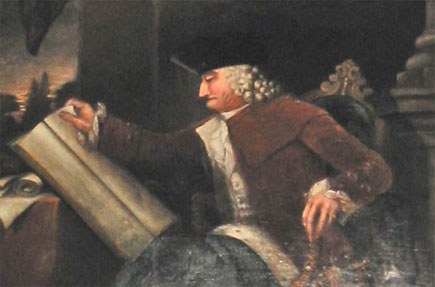
James Edward Oglethorpe, reformer and founder of the Georgia colony.
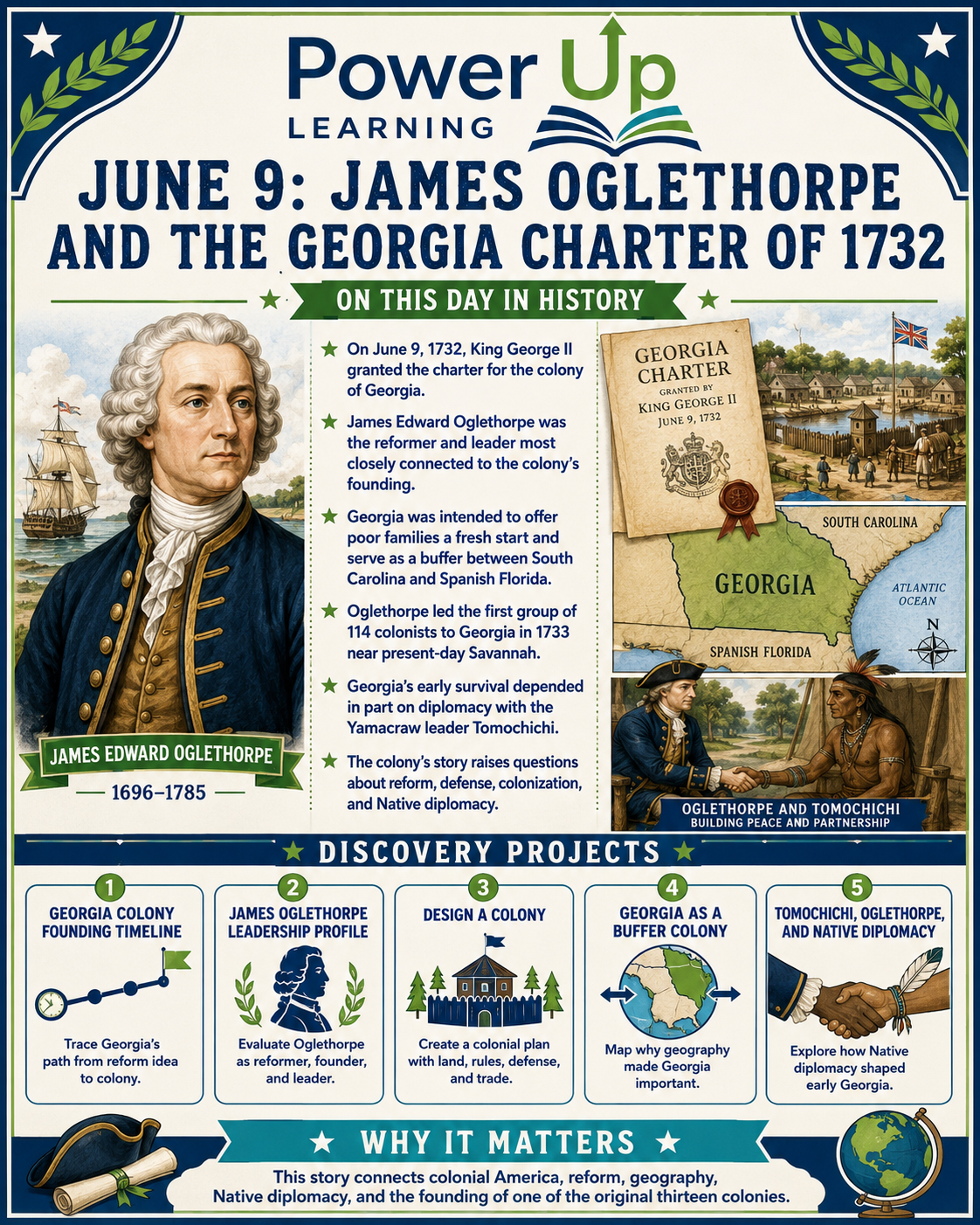
On June 9, 1732, King George II granted a royal charter to the Trustees for Establishing the Colony of Georgia in America. The colony was named for the king, but the person most closely connected to the idea was James Edward Oglethorpe, a British reformer, soldier, and member of Parliament. The Library of Congress explains that Oglethorpe had become concerned about poor and debt-ridden people in London and supported the idea of giving them a fresh start in America. Georgia was also intended to serve as a defensive buffer between South Carolina and Spanish Florida.
Interestingly, Georgia was not founded only for profit. It was also promoted as a social experiment. Oglethorpe and the trustees imagined a colony where poor families could work land, rebuild their lives, and help defend Britain’s southern colonial frontier. The original trustee vision included restrictions on large landholdings, rum, and slavery, though those rules later changed as settlers pushed for more economic freedom. Oglethorpe University notes that Oglethorpe led the first group of 114 colonists to Georgia, landing near present-day Savannah in 1733.
Georgia’s founding also connects students to Native American history. Oglethorpe’s settlement depended on diplomacy with Native leaders, especially the Yamacraw leader Tomochichi, whose relationship with Oglethorpe helped make the early colony possible. This makes the story more complex than a simple founding narrative. It asks students to consider who benefited from colonization, who was displaced or pressured, and how cooperation, trade, land, defense, and power shaped early America.
Discovery Projects
Project 1: Georgia Colony Founding Timeline
Project Goal:
Students will explain how Georgia moved from an idea for reform to the last British colony founded in North America.
Project Description:
Students will create a timeline beginning with Oglethorpe’s prison reform concerns, continuing through the June 9, 1732 charter, the voyage of the first colonists, the founding of Savannah in 1733, and early challenges in the colony.
Final Project Options:
Students may create a poster timeline, digital timeline, illustrated booklet, slideshow, or museum exhibit panel.
Reflection Question:
Why did the founding of Georgia combine charity, defense, economics, and empire?
Project 2: James Oglethorpe Leadership Profile
Project Goal:
Students will evaluate James Oglethorpe as a reformer, founder, soldier, and colonial leader.
Project Description:
Students will research Oglethorpe’s work before and after Georgia’s founding. They should examine his interest in prison reform, his role in gaining the charter, his leadership of the first settlers, and his military concerns about defending the colony.
Final Project Options:
Students may create a biography poster, leadership profile, mock interview, podcast episode, short essay, or “founder report card” evaluating Oglethorpe’s strengths and limits.
Reflection Question:
Can a colony founded with reform ideals still become part of a larger system of empire and inequality?
Project 3: Design a Colony
Project Goal:
Students will understand the difficult choices involved in planning a new colony.
Project Description:
Students will design their own colonial plan using the questions Georgia’s trustees faced. They must decide where to build, how land will be distributed, what rules settlers must follow, how the colony will defend itself, what crops or trades will support the economy, and how the colony will interact with Native nations.
Final Project Options:
Students may create a colony charter, illustrated map, rules-and-rights document, settlement plan, or group presentation.
Reflection Question:
What decisions would make a colony fair, successful, and sustainable — and who gets to decide?
Project 4: Georgia as a Buffer Colony
Project Goal:
Students will analyze why geography made Georgia important to Britain’s colonial strategy.
Project Description:
Students will map the southern colonies, Spanish Florida, Native homelands, rivers, ports, and defensive locations. They will explain why Britain wanted Georgia between South Carolina and Spanish Florida and how geography shaped colonial decisions.
Final Project Options:
Students may create an annotated map, military strategy briefing, cause-and-effect chart, or geography-based slideshow.
Reflection Question:
How does geography influence political and military decisions?
Project 5: Tomochichi, Oglethorpe, and Native Diplomacy
Project Goal:
Students will examine how Native diplomacy shaped the early survival of Georgia.
Project Description:
Students will research the relationship between Tomochichi, the Yamacraw people, and James Oglethorpe. They will consider how diplomacy, trade, land agreements, and cultural exchange affected the early colony. Students should also evaluate the limits of cooperation in a colonial system that increasingly pressured Native lands.
Final Project Options:
Students may create a two-perspective dialogue, diplomatic meeting reenactment, museum exhibit panel, illustrated map, or short research essay.
Reflection Question:
Why is it important to study colonial founding stories from both European and Native perspectives?