June 13: The Marquis de Lafayette Arrives in America

The Marquis de Lafayette, a young French aristocrat who came to America to support the Revolutionary War.
On June 13, 1777, the Marquis de Lafayette landed near Georgetown, South Carolina, after crossing the Atlantic aboard a ship he had purchased himself, the Victoire. He was only 19 years old, but he came determined to join the American Revolution and support the Continental Army. The Marquis de Lafayette was born Marie-Joseph Paul Yves Roch Gilbert du Motier de La Fayette on September 6, 1757, into a noble family in France. Although he was young and wealthy, Lafayette became deeply interested in the American struggle for independence. At only nineteen years old, he purchased a ship, sailed across the Atlantic, and arrived in America in 1777 to volunteer for the Continental Army. His decision was courageous because France had not yet officially joined the war against Great Britain, and Lafayette risked his reputation, fortune, and safety to support the American cause.
Lafayette quickly became an important figure in the American Revolution. The Continental Congress appointed him a major general, and he developed a close relationship with George Washington, who became both a mentor and father-like figure to him. Lafayette proved his courage at the Battle of Brandywine, where he was wounded while helping organize a retreat. He also served at Valley Forge and later commanded troops in Virginia. During the final phase of the war, Lafayette helped contain British forces under Lord Cornwallis until Washington and French forces could arrive, contributing to the victory at Yorktown in 1781.
Lafayette’s contribution to America’s independence went beyond his military service. He helped strengthen the relationship between the United States and France, a partnership that became essential to the American victory. French money, troops, supplies, and naval support helped the colonies continue the war and ultimately defeat the British. Lafayette became a lasting symbol of international friendship, youthful courage, and commitment to liberty. His life reminds students that the American Revolution was not only an American story, but also part of a larger Atlantic struggle over freedom, rights, and self-government.

Currier and Ives illustration, 1876
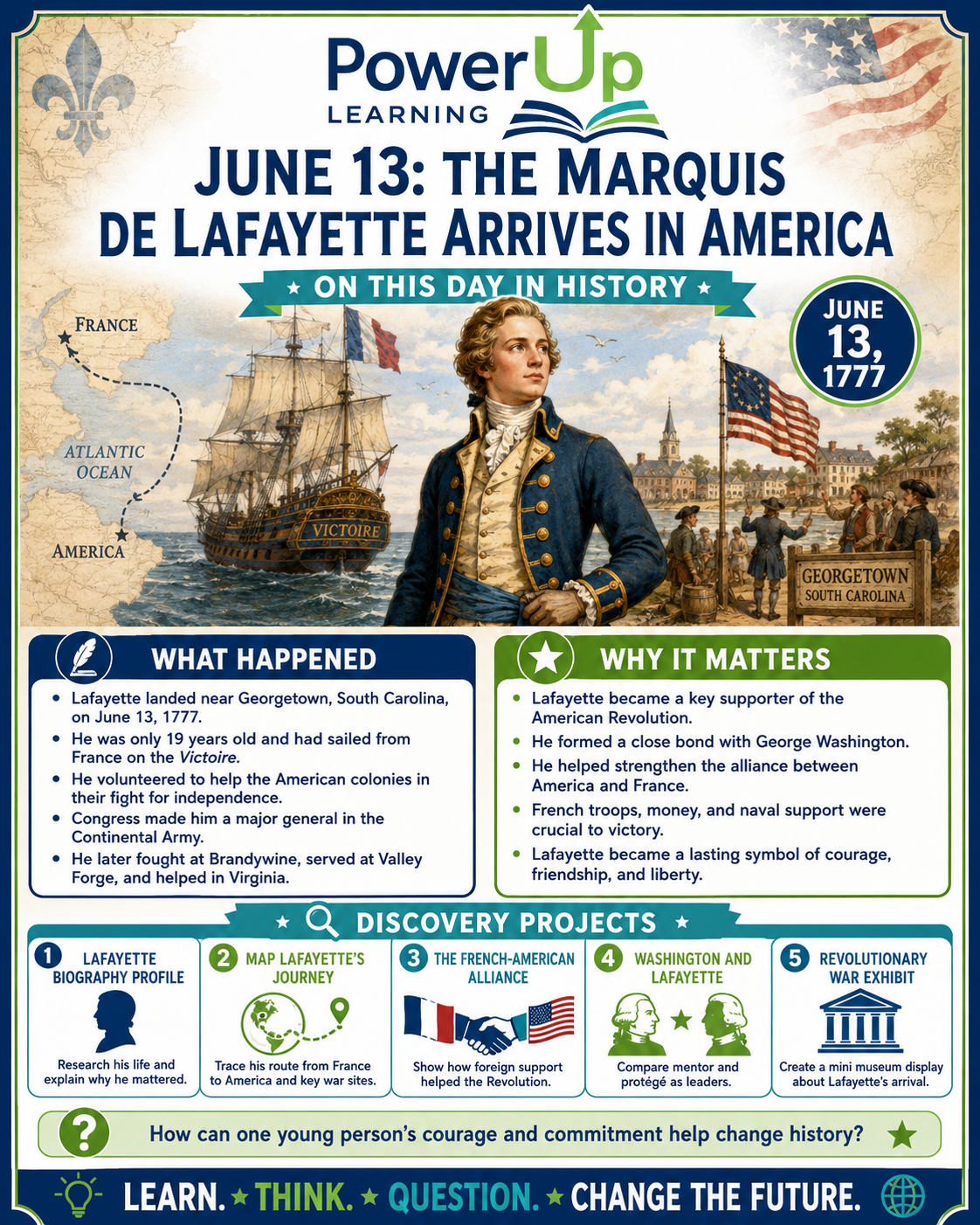
Discovery Projects
1. Lafayette Biography Profile
Project Goal:
Students will explain why the Marquis de Lafayette became an important figure in the American Revolution and a lasting symbol of French-American friendship.
Focus of Study:
This project focuses on Lafayette’s early life, his decision to leave France, his arrival in America, his military service, his relationship with George Washington, and his role in helping the American colonies win independence.
Project Description:
Students research Lafayette’s life and create a biography profile that explains his motivations, accomplishments, and historical importance. Final products could include a biography poster, timeline, podcast episode, museum panel, or illustrated profile.
2. Map Lafayette’s Journey
Project Goal:
Students will understand how geography, travel, and military movement shaped Lafayette’s role in the American Revolution.
Focus of Study:
This project focuses on Lafayette’s journey from France to South Carolina, his travel to Philadelphia, and his involvement in key Revolutionary War locations such as Brandywine, Valley Forge, and Yorktown.
Project Description:
Students create a map showing Lafayette’s path from France to America and then to important Revolutionary War sites. Older students can add dates, distances, primary-source excerpts, and explanations of why each location mattered.
3. The French-American Alliance
Project Goal:
Students will analyze why international support was important to the success of the American Revolution.
Focus of Study:
This project focuses on the relationship between France and the American colonies, the reasons France supported the American cause, and the ways French military, financial, and naval support helped change the outcome of the war.
Project Description:
Students investigate the French-American alliance and explain how foreign assistance helped the colonies. Final products could include a cause-and-effect chart, debate, diplomatic briefing, illustrated infographic, or short presentation.
4. Washington and Lafayette: Mentor and Protégé
Project Goal:
Students will examine how leadership, trust, and mentorship shaped Lafayette’s development as a military leader.
Focus of Study:
This project focuses on the relationship between George Washington and Lafayette, including their differences in age, background, experience, and leadership style.
Project Description:
Students compare Washington and Lafayette and explain how their relationship influenced Lafayette’s service in the Continental Army. Final products might include a two-person biography, dialogue script, leadership comparison chart, or “lessons in leadership” presentation.
5. Design a Revolutionary War Exhibit
Project Goal:
Students will synthesize historical information into a museum-style exhibit that teaches others why Lafayette’s arrival in America mattered.
Focus of Study:
This project focuses on Lafayette’s arrival on June 13, 1777, his service in the American Revolution, his connection to Washington, and his lasting importance in American and French history.
Project Description:
Students create a mini museum exhibit titled “Lafayette and the American Revolution.” The exhibit should include images, captions, a map, a timeline, key vocabulary, and an explanation of why Lafayette’s arrival helped strengthen the American cause.