June 14: Harriet Beecher Stowe is born 1811
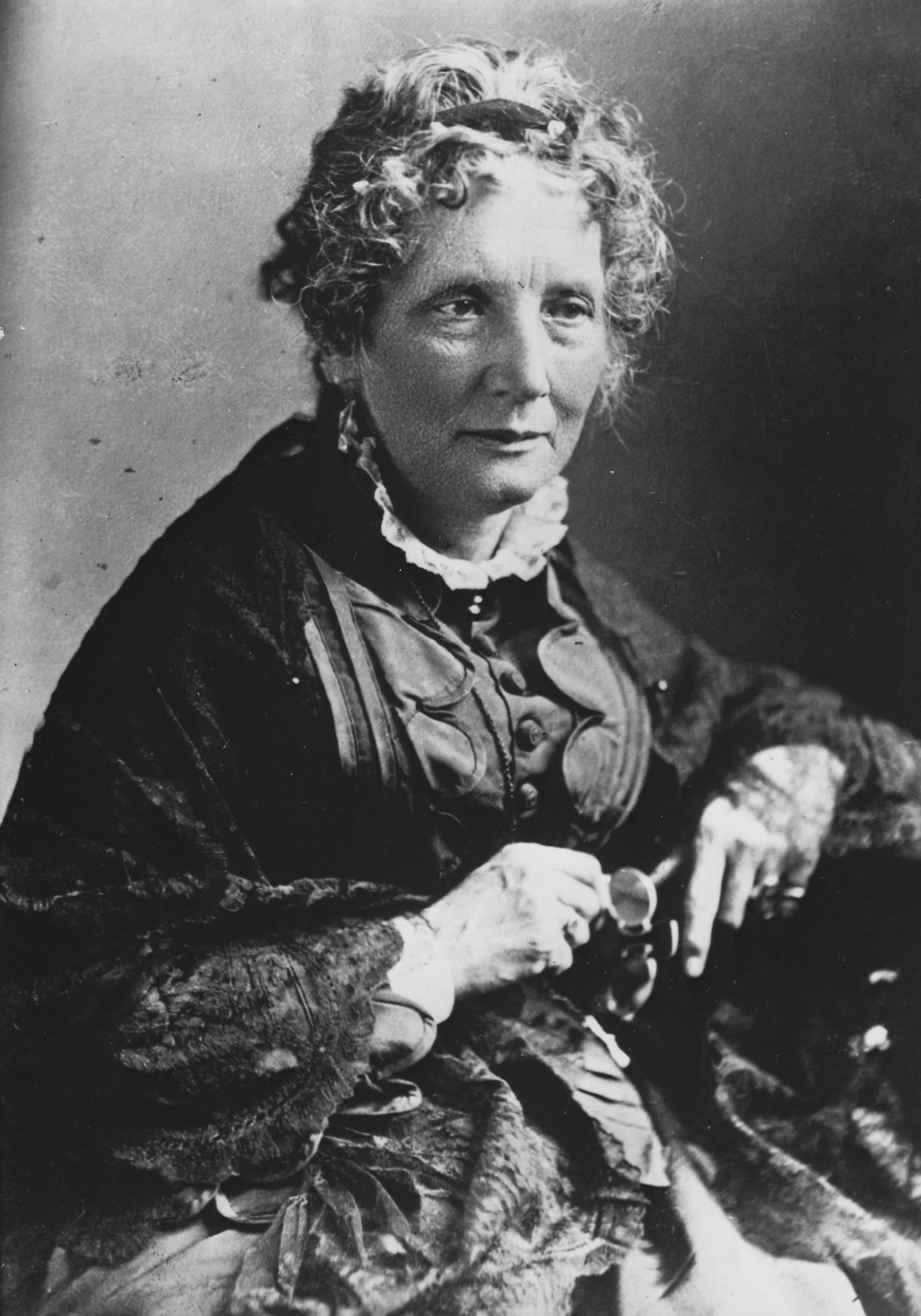
Harriet Beecher Stowe | Library of Congress
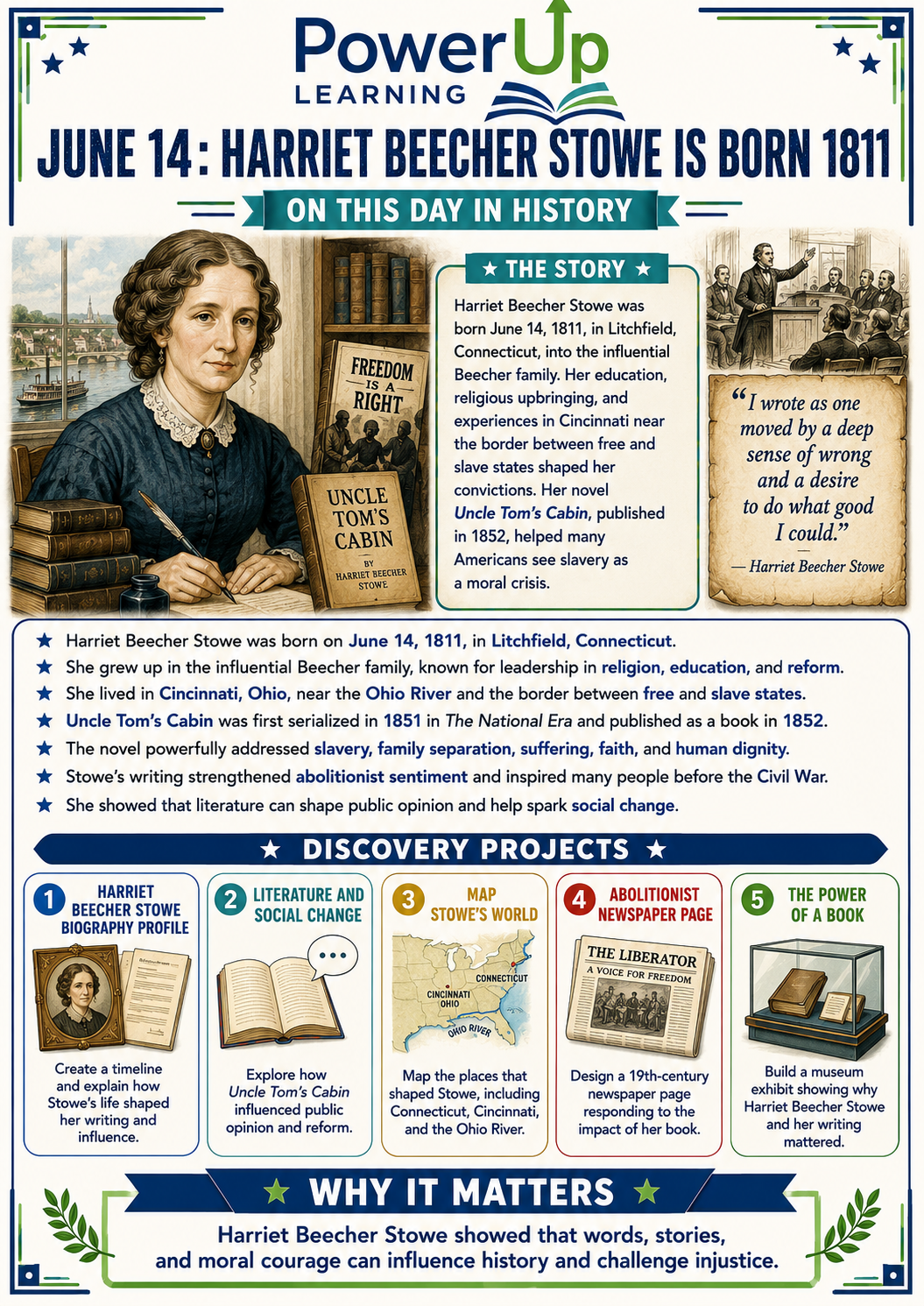
Harriet Beecher Stowe was born on June 14, 1811, in Litchfield, Connecticut, into the well-known Beecher family, a family deeply involved in religion, education, and reform. Her father, Lyman Beecher, was a prominent minister, and several of her siblings also became influential public figures. Stowe was educated at a time when many women had limited formal opportunities, but she developed strong reading, writing, and critical thinking skills. Her life in Cincinnati, Ohio, near the border between free and slave states, exposed her to debates over slavery and to stories of people who had escaped bondage. These experiences shaped her moral convictions and helped inspire her writing.
Stowe became nationally famous for her novel Uncle Tom’s Cabin, which was first published in serial form in 1851 and then as a book in 1852. The novel told a powerful story about slavery, family separation, suffering, faith, and human dignity. It reached a large audience and helped many readers understand slavery as a moral crisis rather than simply a political issue. While the book was praised by abolitionists, it was strongly criticized by many defenders of slavery, especially in the South. Its emotional storytelling made it one of the most influential works of American literature before the Civil War.
Harriet Beecher Stowe’s impact extended far beyond her success as an author. She showed that literature could shape public opinion, challenge injustice, and influence national debate. Although she did not hold political office or command an army, her words helped strengthen the abolitionist movement and increased opposition to slavery in the years before the Civil War. Her legacy is important because she demonstrated the power of writing to move people, expose injustice, and inspire social change. Stowe remains a central figure in American literary history, women’s history, and the history of reform.
Discovery Projects
1. Harriet Beecher Stowe Biography Profile
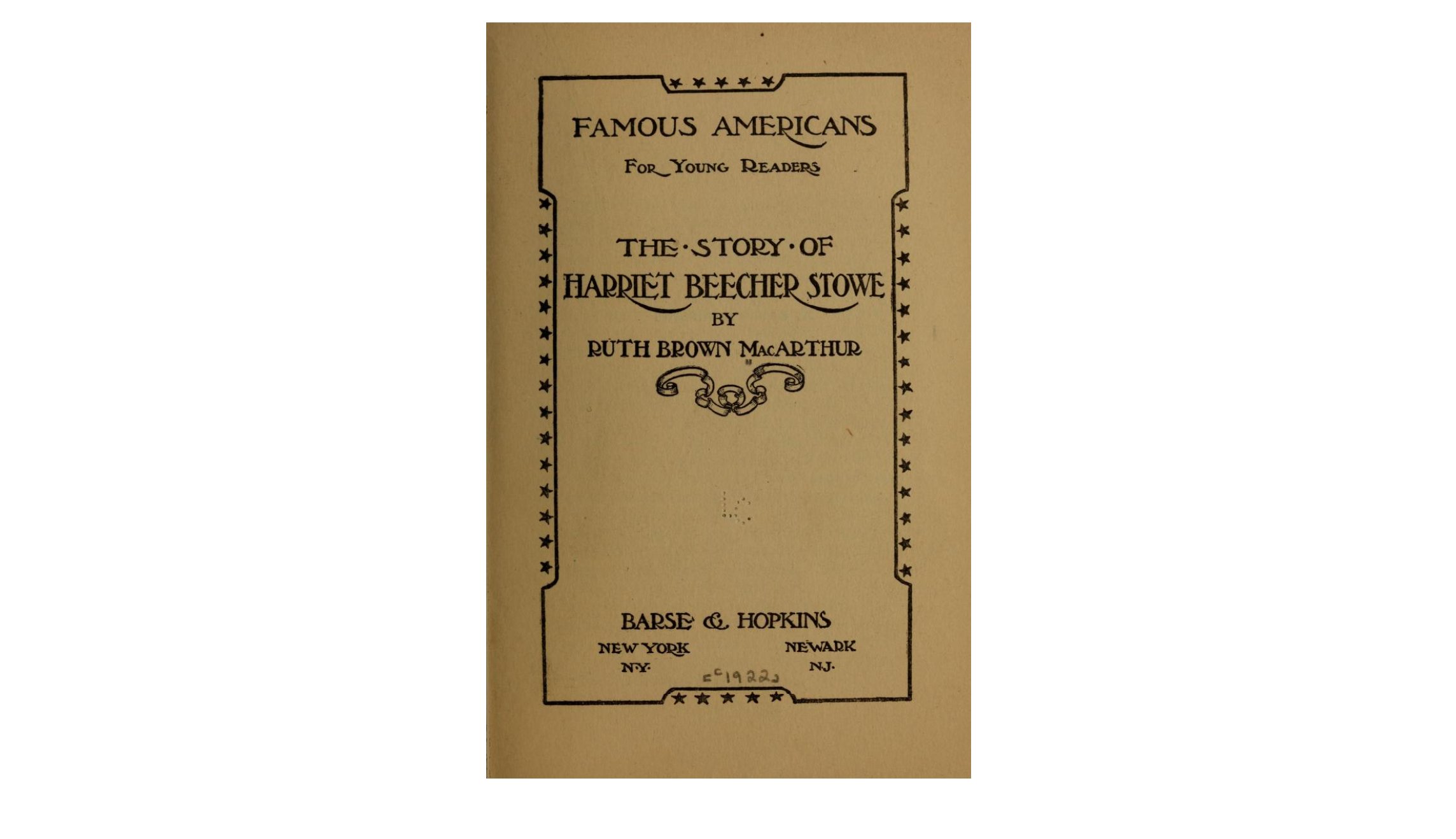
1881 biography of Harriet Beecher Stowe available at the Library of Congress https://www.loc.gov/item/22015489/
Project Goal:
Students will explain how Harriet Beecher Stowe became an influential writer and reformer whose work helped shape public opinion about slavery.
Focus of Study:
This project focuses on Stowe’s early life, education, religious upbringing, family influences, and experiences living near the border between free and slave states. Students should examine how her personal experiences, moral beliefs, and exposure to abolitionist ideas shaped her writing. They should also study how Uncle Tom’s Cabin made Stowe a nationally known author and why her work became important in the years leading up to the Civil War.
Suggested Project Management Directions:
Begin by having students create a simple timeline of Stowe’s life, including her birth, education, family background, move to Cincinnati, writing career, publication of Uncle Tom’s Cabin, and later public influence. Next, students should choose 5–7 key events from her life and explain why each mattered. Encourage students to use a mix of text and visuals, such as portraits, maps, book images, or short quotations. For a final product, students may create a biography poster, slideshow, podcast script, museum panel, or illustrated timeline. Older students should include a short paragraph explaining how Stowe’s life experiences shaped her writing.
2. Literature and Social Change
Project Goal:
Students will analyze how literature can influence public opinion, raise moral questions, and contribute to social reform.
Focus of Study:
This project focuses on the power of storytelling as a tool for change. Students should study how Uncle Tom’s Cabin used characters, family separation, suffering, faith, and moral conflict to help readers understand the human cost of slavery. Students should also consider why the book had such a strong emotional impact, why it angered many defenders of slavery, and how written works can influence public debate.
Suggested Project Management Directions:
Start by asking students to identify a central question: Can a book help change history? Students should research how Uncle Tom’s Cabin was published, who read it, and how different groups reacted to it. They can then choose one theme to study, such as family separation, moral responsibility, public persuasion, or abolitionist writing. Students should create a cause-and-effect chart showing how literature can move from private reading to public discussion and social action. Final products could include an analytical poster, classroom debate, short essay, presentation, or comparison between Stowe’s work and another example of writing that influenced society.
3. Map Harriet Beecher Stowe’s World
Project Goal:
Students will understand how geography shaped Harriet Beecher Stowe’s perspective and helped influence her writing.
Focus of Study:
This project focuses on the places connected to Stowe’s life and the larger geography of slavery and freedom in the United States. Students should study Litchfield, Hartford, Cincinnati, the Ohio River, free states, slave states, and Underground Railroad activity. The project should help students understand that location matters: living in Cincinnati placed Stowe near the border between slavery and freedom, where she could hear stories and witness tensions that influenced her thinking.
Suggested Project Management Directions:
Have students begin with a blank map of the eastern United States. They should mark important places in Stowe’s life and label each location with a short explanation. Students can add arrows showing movement, shaded regions for free and slave states, and symbols for important places such as schools, churches, publishing centers, and Underground Railroad connections. Younger students may create a visual map with short captions, while older students can add historical context about each location. The final project may be a large map poster, digital map, travel journal, or “places that shaped Stowe” exhibit.
4. Create an Abolitionist Newspaper Page
Project Goal:
Students will communicate historical ideas through persuasive writing, visual design, and 19th-century newspaper-style presentation.
Focus of Study:
This project focuses on abolitionist communication and the role of newspapers, pamphlets, editorials, and public writing in reform movements. Students should study how people in the 1800s shared ideas, persuaded readers, and responded to major issues such as slavery. The project should also help students understand how headlines, images, captions, editorials, and short articles can shape public opinion.
Suggested Project Management Directions:
Begin by having students look at examples of 19th-century newspaper layouts or abolitionist writing. Then ask them to create a newspaper page from the 1850s responding to the publication or influence of Uncle Tom’s Cabin. The page should include a main headline, one short news article, one editorial or opinion piece, one image with a caption, and one small sidebar such as “Key Facts,” “Voices of Reform,” or “Questions for Readers.” Students should write from a historically informed perspective, avoiding modern slang while keeping the language understandable. This project can be managed over several days: research first, draft articles next, design the layout, revise for accuracy, and then present the newspaper to the class or family.
5. Design a Museum Exhibit: “The Power of a Book”
Project Goal:
Students will synthesize historical information into a museum-style exhibit that teaches others why Harriet Beecher Stowe and Uncle Tom’s Cabin mattered.
Focus of Study:
This project focuses on historical interpretation, exhibit design, and the relationship between literature and public memory. Students should study Stowe’s life, the publication of Uncle Tom’s Cabin, reactions to the book, its role in abolitionist debate, and its connection to the years before the Civil War. Students should also consider how museums choose artifacts, images, captions, and organizing questions to help visitors understand a topic.
Suggested Project Management Directions:
Have students begin by choosing a central exhibit question, such as How did one book influence the national conversation about slavery? Students should then select 4–6 exhibit sections, such as “Harriet Beecher Stowe’s Life,” “The World of Slavery and Abolition,” “Writing Uncle Tom’s Cabin,” “Public Reaction,” and “Legacy.” Each section should include a title, short explanation, image or artifact, and caption. Students may create a trifold board, digital slide exhibit, hallway display, or tabletop museum. To manage the project, assign steps: research, outline exhibit sections, gather images, write captions, design layout, and prepare a short guided tour explaining the exhibit to an audience.