June 16: LaMarcus Thompson and America’s First Roller Coaster
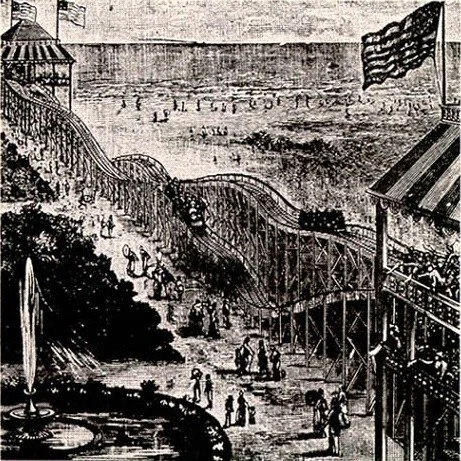
Thompson’s Switchback Railway at Coney Island, opened in 1884.
On June 16, 1884, inventor and businessman LaMarcus Adna Thompson opened the Gravity Pleasure Switchback Railway at Coney Island in Brooklyn, New York. Often described as America’s first amusement roller coaster, the ride was far slower and simpler than modern coasters. Passengers rode along a gravity-powered track at about six miles per hour and paid a nickel for the experience. The American Society of Civil Engineers describes the ride as an immediate success. Later roller coaster designs were built on Thompson’s early work.
Thompson based his creative invention on the physics he identified in earlier inventions. Gravity railways, including mining railways and scenic rail lines, helped inspire amusement rides, but Thompson helped turn the concept into a commercial entertainment experience. His Switchback Railway used engineering, gravity, height, speed, and public curiosity to create a new kind of attraction. In 1885, Thompson received a patent for his “Roller Coasting Structure,” and his work helped launch the modern amusement ride industry.

LaMarcus Adna Thompson, remembered as a pioneer of the American roller coaster.
Coney Island became one of America’s most famous centers of public entertainment in the late nineteenth and early twentieth centuries. Located in Brooklyn, New York, it developed from a seaside resort into a lively amusement district as railroads, streetcars, and later subway access made it easier for large numbers of city residents to visit. Families, workers, immigrants, and tourists came for the beach, food, games, sideshows, music, rides, and the thrill of new attractions. By the 1880s, Coney Island reflected the growth of urban leisure in America, showing how industrial cities created both the need and the opportunity for affordable recreation. LaMarcus Thompson’s Switchback Railway fit perfectly into this setting because it offered visitors something exciting, mechanical, and modern. Over time, Coney Island helped shape the amusement park industry and became a symbol of how Americans used technology, creativity, and public spaces to create shared experiences of fun and wonder.
The physics behind roller coaster design begins with gravity and energy. A coaster usually starts by pulling the car to the top of a hill, where it gains gravitational potential energy because of its height. As the car moves downhill, that stored energy changes into kinetic energy, or energy of motion, causing the coaster to speed up. Designers use height, slope, curves, friction, and momentum to control how fast the car moves and how safely it travels along the track. Friction from the wheels and air resistance gradually slow the coaster down, while carefully shaped hills and turns help manage speed and force. Modern roller coasters may look thrilling, but they depend on precise engineering so that gravity, motion, and safety work together to create an exciting ride.
Why It Matters
LaMarcus Thompson’s roller coaster shows how engineering can become entertainment. His work helped transform amusement from small local attractions into a larger commercial industry. The Switchback Railway also gives students a useful historical question: How do inventions change the way people live, gather, spend money, and experience excitement?
Discovery Projects
Project 1: LaMarcus Thompson Inventor Profile
Student Leadership Focus:
Students manage the research, organization, and presentation of LaMarcus Thompson’s life and work as an inventor.
Student Planning Steps:
Students begin by creating a team research board with four sections: Who was LaMarcus Thompson? What did he invent? Why did the Switchback Railway matter? How did it influence American entertainment? The team should decide which student will research biographical information, which student will investigate Coney Island, which student will study the Switchback Railway, and which student will design the final product.
Students should choose their final format before they begin full research. Options may include a biography poster, inventor profile, timeline, podcast script, museum panel, or short presentation. Once the format is chosen, students should create a checklist of required parts: title, image, key dates, invention description, historical importance, and final reflection.
Student Work Process:
Students should gather facts from reliable sources, record them in their own words, and decide which information is most important for the audience. The project manager should check that each team member is completing their assigned section. The designer should begin arranging the visual layout while the writers prepare captions and explanations. Students should meet at least once during the project to ask: What have we completed? What still needs work? What information is missing?
Presentation:
Students present Thompson as an inventor who changed entertainment. Each team member should explain one part of the project. The presentation should end by answering: How can one invention change the way people spend their free time?
Project 2: Build a Roller Coaster Physics Model
Student Leadership Focus:
Students manage the design, testing, revision, and explanation of a working roller coaster model.
Student Planning Steps:
Students begin by forming an engineering team. They should assign roles such as lead designer, materials manager, builder, test engineer, data recorder, and presenter. The team should decide what materials they will use and sketch the first version of the coaster before building. Their design should include a starting hill, track path, turns or drops, support structures, and a stopping area.
Students should create a testing chart before construction begins. The chart may include starting height, track length, number of test runs, number of successful runs, problems observed, and changes made. Older students may add measurements for time, distance, and average speed.
Student Work Process:
Students build the first version of the coaster and test it multiple times. The team should treat failure as part of the engineering process. If the marble or car falls off, stops too soon, or moves too quickly, students should discuss what caused the problem and decide what to change. The data recorder should document each test. The project manager should lead short team meetings after each round of testing.
Students should revise the model at least once based on evidence. They should be able to explain why they made each design change. The final model does not need to be perfect, but it should show thoughtful planning, testing, and improvement.
Presentation:
Students demonstrate the model and explain how gravity, height, slope, friction, and design affect motion. Each team member should explain one part of the engineering process. The presentation should answer: How does a roller coaster turn energy and design into motion?
Project 3: Coney Island and American Leisure
Student Leadership Focus:
Students manage a historical investigation into how Coney Island became an important place in American entertainment.
Student Planning Steps:
Students begin by creating a project question board. Possible questions include: Why did people visit Coney Island? What made it exciting? How did transportation, cities, and technology help amusement parks grow? What does entertainment reveal about American culture?
Students should choose a final product such as a historic travel brochure, illustrated map, newspaper article, photo exhibit, slideshow, or “day at Coney Island” diary. After choosing the format, students should divide responsibilities. One student may research transportation, another amusement rides, another crowds and public leisure, another images and captions, and another design.
Student Work Process:
Students gather information and images, then decide how to organize the story for an audience. They should create sections such as What Visitors Saw, Why Coney Island Became Popular, and How Amusement Parks Changed American Leisure. Students should decide which facts are essential and which details are interesting but less important.
The student project manager should hold a midpoint check-in. During this meeting, the team should review whether the project has a clear main idea, accurate historical information, strong visuals, and a logical layout.
Presentation:
Students present their project as historians or tour guides. If they create a brochure, they may “sell” Coney Island as an 1880s attraction. If they create a newspaper article, they may read it as a reporter. If they create a photo exhibit, they may guide viewers through the images. The presentation should answer: What does a place of entertainment reveal about the society that created it?
Project 4: Patent Drawing and Invention Study
Student Leadership Focus:
Students manage the process of studying a historical patent and designing their own amusement-ride invention.
Student Planning Steps:
Students begin by examining Thompson’s roller coaster patent drawing. As a team, they should list what they notice, what they wonder, and what they think each part does. Students should then create a simple chart with three columns: Part of the Invention, What It Does, and Why It Matters.
Next, students become inventors. They should decide what kind of amusement ride they want to design. The team should assign roles such as chief inventor, technical illustrator, safety specialist, writer, and presenter. Their invention should include movement, rider experience, safety features, and something original.
Student Work Process:
Students create a patent-style drawing with labels. The drawing should be clear enough that another person can understand how the ride works. Students should include at least six labeled parts and a written explanation of how the ride moves, how riders are kept safe, and what makes the invention different.
The safety specialist should lead a review of the design by asking: What could go wrong? How would riders enter and exit safely? What prevents falls or collisions? What materials would be needed?
Presentation:
Students present their invention as though they are speaking to a patent examiner or investors. Each student should explain one part of the design. The presentation should answer: Why do inventors need both creative ideas and clear technical communication?
Project 5: Design a Modern Amusement Park Exhibit
Student Leadership Focus:
Students manage a museum-style exhibit comparing Thompson’s early roller coaster with modern amusement rides.
Student Planning Steps:
Students begin by choosing an exhibit question, such as: How did roller coasters change from simple gravity rides into modern thrill rides? The team should then decide the exhibit format: trifold board, digital slide exhibit, tabletop display, hallway exhibit, or video tour.
Students should divide the exhibit into sections. Possible sections include The First Ride, How Gravity Makes It Work, Coney Island and Public Entertainment, Safety Then and Now, Modern Roller Coaster Technology, and Why People Seek Thrills. Each student or pair of students should take responsibility for one section.
Student Work Process:
Students research their sections, gather visuals, write captions, and prepare short explanations. The team should create a shared exhibit checklist to make sure every section includes a title, image or drawing, caption, explanation, and connection to the main question.
Students should also write a short curator’s statement explaining the main idea of the exhibit. This statement should not simply summarize the project. It should explain what the history of roller coasters teaches about invention, entertainment, technology, and public excitement.
Presentation:
Students lead a guided museum tour. Each student explains one exhibit section and answers questions from the audience. The team should close with a group reflection: How does technology change what people consider exciting, safe, or entertaining?