June 20: Arthur Boreman and West Virginia Statehood

Arthur I. Boreman, first governor of West Virginia | public domain
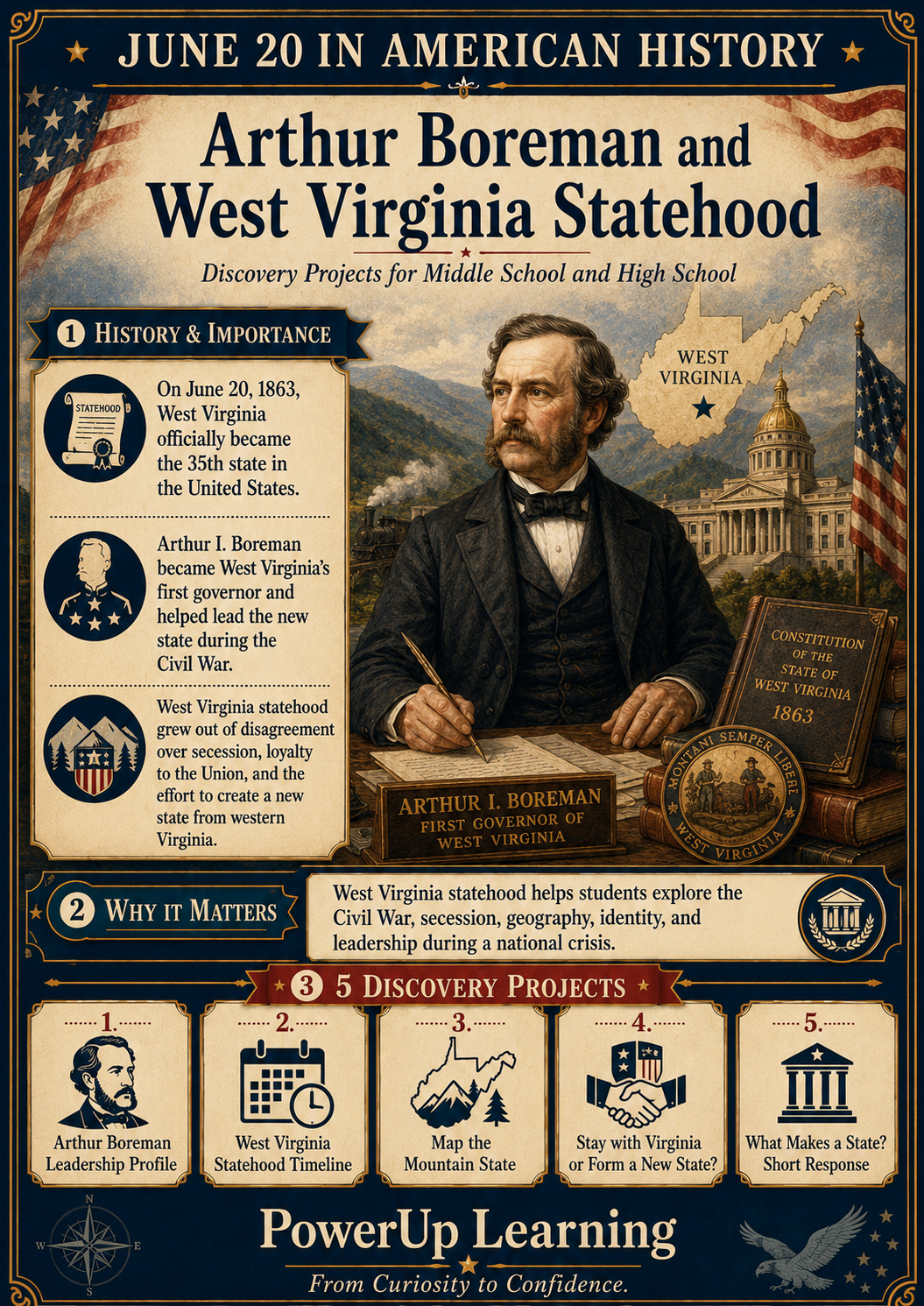
On June 20, 1863, West Virginia officially became the 35th state in the United States. Its statehood was unusual because it happened during the Civil War. When Virginia voted to secede from the Union in 1861, many people in the western counties did not agree with secession. These western counties had different economic, political, and geographic interests than eastern Virginia, and many residents wanted to remain loyal to the United States.
A key person connected to this event was Arthur I. Boreman, who became West Virginia’s first governor on June 20, 1863. Born in Pennsylvania in 1823 and raised in what is now West Virginia, Boreman became active in law and politics before the Civil War. When Virginia seceded from the Union in 1861, Boreman supported the movement among western Virginia counties to remain loyal to the United States. He served as president of the Second Wheeling Convention, which helped create the political pathway for West Virginia statehood. On June 20, 1863, the same day West Virginia officially became a state, Boreman was inaugurated as its first governor.
As governor, Boreman faced the difficult task of leading a brand-new state during the Civil War. West Virginia contained both Union and Confederate sympathizers, so his leadership required political firmness, loyalty to the Union, and the building of new state institutions. He supported public education, helped establish West Virginia University, and later served in the U.S. Senate. His career is important because it connects statehood, Civil War loyalty, constitutional questions, public education, and Reconstruction-era politics.
West Virginia statehood is important because it shows how deeply the Civil War divided not only the nation, but also individual states and communities. It also raises important questions about loyalty, self-government, constitutional authority, and the meaning of Union. West Virginia was not simply added to the map; it was born out of conflict, disagreement, and the struggle to define what it meant to remain part of the United States.
Why It Matters
West Virginia statehood helps students explore the Civil War, secession, federalism, geography, constitutional questions, and leadership during a national crisis. It raises important historical questions: Can a new state be formed from an existing state during wartime? What happens when people within one state disagree about loyalty to the nation? How do geography, economy, and political beliefs shape identity?
Discovery Projects
Project 1: Arthur Boreman Leadership Profile
Project Goal:
Create a one-page leadership profile about Arthur I. Boreman and his role as West Virginia’s first governor.
What to Include:
The profile should include Boreman’s name, his role in West Virginia statehood, the date he became governor, and a short explanation of the challenges he faced leading a new state during the Civil War. Include at least three leadership qualities he may have needed.
Student Directions:
Research Arthur Boreman and West Virginia’s early statehood. Take notes about his role in the statehood movement and his responsibilities as governor. Then create a one-page profile that explains why his leadership mattered during a difficult moment in American history.
Final Product:
A one-page illustrated leadership profile.
Reflection Question:
What challenges would a governor face when leading a brand-new state during a civil war?
Project 2: West Virginia Statehood Timeline
Project Goal:
Create a timeline showing the major events that led to West Virginia becoming a state.
What to Include:
The timeline should include at least six events. Possible events include Virginia’s secession, the Wheeling Conventions, the Restored Government of Virginia, congressional debate over statehood, Lincoln’s approval, the Willey Amendment, and West Virginia officially becoming a state on June 20, 1863.
Student Directions:
Research the events that led to West Virginia statehood. Put the events in chronological order. For each event, write one or two sentences explaining what happened. Add small drawings, symbols, or maps to make the timeline visually clear.
Final Product:
A paper or digital timeline.
Reflection Question:
Which event on your timeline seems most important to West Virginia becoming a state? Why?
Project 3: Map the Mountain State
Project Goal:
Create a map project showing how geography helped shape West Virginia’s identity.
What to Include:
The map should show West Virginia, Virginia, the Appalachian Mountains, and important locations connected to statehood, such as Wheeling. Students may also label rivers, mountain regions, neighboring states, and Union or Confederate areas.
Student Directions:
Study a map of Virginia and West Virginia during the Civil War period. Then create a labeled map that helps explain why the western counties had different interests from eastern Virginia. Use color, labels, and a short caption to explain how geography influenced politics and identity.
Final Product:
A labeled historical map with a short explanation.
Reflection Question:
How can geography influence whether people feel connected to one region or another?
Project 4: Stay with Virginia or Form a New State? Decision Organizer
Project Goal:
Create a decision organizer showing arguments for and against forming West Virginia.
What to Include:
Divide the organizer into two sides: Reasons to Stay with Virginia and Reasons to Form a New State. Include at least three points on each side. At the bottom, write a short conclusion explaining what decision you would have supported if you lived in western Virginia in 1863.
Student Directions:
Research why some western Virginians opposed secession and wanted to form a new state. Also think about why creating a new state during the Civil War would have been complicated. Use evidence to explain both sides before writing your conclusion.
Final Product:
A two-column decision chart with a short conclusion.
Reflection Question:
Why is it important to understand both sides of a major historical decision?
Project 5: What Makes a State? Short Response Project
Project Goal:
Write a short response explaining what West Virginia statehood teaches about government, loyalty, and identity.
What to Include:
The response should explain what happened on June 20, 1863, why West Virginia’s statehood was unusual, and what the event shows about the Civil War. Students should include at least one historical fact about Abraham Lincoln, Arthur Boreman, Virginia’s secession, or the creation of West Virginia.
Student Directions:
Begin by defining the word statehood in your own words. Then explain why West Virginia’s path to becoming a state was different from most other states. Use historical evidence to support your answer.
Middle school students may write 2–3 paragraphs. High school students may write 4–5 paragraphs and include more historical evidence.
Final Product:
A short written response or essay.
Reflection Question:
What does West Virginia’s creation show about the meaning of loyalty during the Civil War?
Student Project Tips
Students should begin by reading about West Virginia statehood, Arthur Boreman, Virginia’s secession, and the Civil War. They should take notes and choose the project format that best fits their strengths. Some students may prefer creating a timeline or map, while others may prefer writing, researching leadership, or analyzing a difficult political decision.
Before beginning, students should ask:
What is the main question I am answering?
What information do I need to find?
What final product will I create?
How will I show what I learned?
When the project is finished, students should review their work and make sure it is accurate, organized, and clear. Each project should help the student understand why June 20, 1863, became an important date in American history.