June 21: New Hampshire and the Ratification of the U.S. Constitution
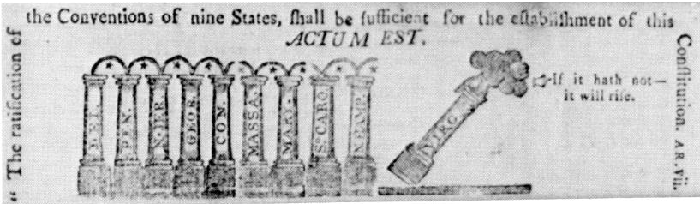
The Ninth Pillar, June 21, 1788 | Library of Congress
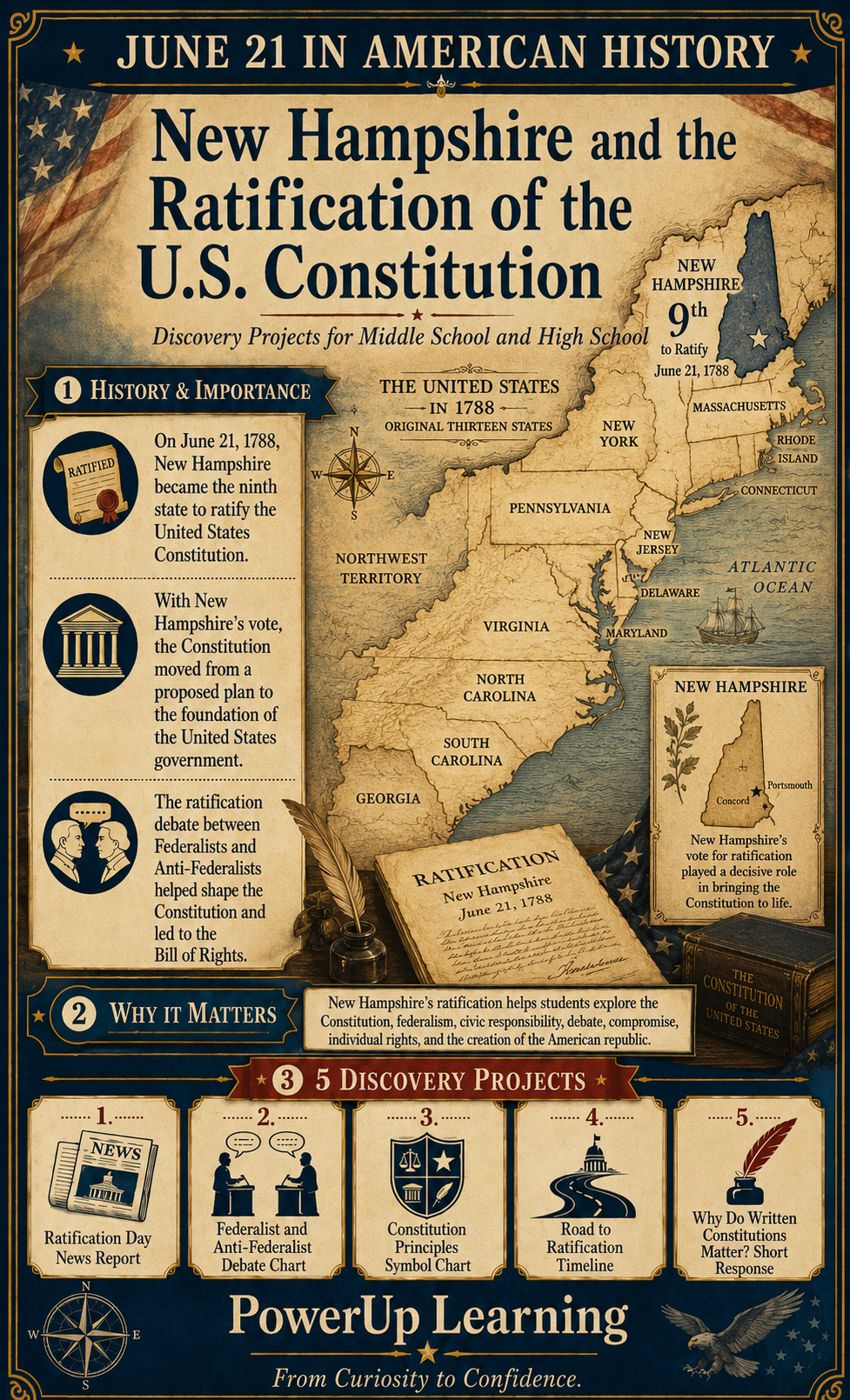
On June 21, 1788, New Hampshire became the ninth state to ratify the United States Constitution. This was a major turning point in American history because the Constitution required approval from nine states before it could become the official framework for the new national government. With New Hampshire’s vote, the Constitution moved from a proposed plan to the foundation of the United States government.

The ratification process was not simple. Americans debated whether the Constitution gave the national government too much power or whether a stronger central government was necessary to hold the country together. Supporters of the Constitution, known as Federalists, believed the Articles of Confederation had created a weak national government that could not effectively manage trade, debt, defense, or disputes between states. Opponents, often called Anti-Federalists, worried that the Constitution might threaten individual liberties and state authority.
Federalists supported ratification of the United States Constitution because they believed the country needed a stronger national government. Under the Articles of Confederation, the federal government had limited power to collect taxes, regulate trade, settle disputes between states, or respond effectively to national problems. Federalists argued that the Constitution created a more stable republic by dividing power among three branches of government, using checks and balances, and allowing the national government to act with greater authority. They believed a stronger central government was necessary to protect the nation, manage the economy, maintain order, and preserve the Union.
Anti-Federalists opposed or questioned ratification because they feared the Constitution gave too much power to the national government and did not do enough to protect individual liberties or state authority. Many worried that a powerful president, federal courts, and Congress might become too distant from ordinary citizens and too similar to the British government Americans had fought against during the Revolution. They argued that the Constitution needed a clear list of protected rights before it should be accepted. Their concerns helped lead to the adoption of the Bill of Rights, which became the first ten amendments to the Constitution and protected freedoms such as speech, religion, due process, and the right to petition the government.
New Hampshire’s ratification mattered because it helped launch a new constitutional system. The Constitution created a government with three branches, checks and balances, federalism, and a process for amendment. The debate over ratification also helped lead to the adoption of the Bill of Rights, which protected freedoms such as speech, religion, due process, and the right to petition the government.
Why It Matters
New Hampshire’s ratification helps students explore the Constitution, federalism, civic responsibility, debate, compromise, individual rights, and the creation of the American republic. It raises important historical questions: How should power be divided between state and national governments? Why do written constitutions matter? How can disagreement lead to stronger protections for citizens?
Discovery Projects
Project 1: Ratification Day News Report
Project Goal:
Write a short newspaper report announcing that New Hampshire has become the ninth state to ratify the Constitution.
What to Include:
The news report should include a headline, date, location, opening paragraph, important facts, and a short explanation of why the ninth ratification mattered. Students should explain that New Hampshire’s vote allowed the Constitution to move forward as the new plan of government.
Student Directions:
Research what happened on June 21, 1788, and write as if you are a newspaper reporter covering the news. Answer who, what, when, where, why, and how. Try to explain the event clearly for readers who may not understand why the ninth state was so important.
Final Product:
A one-page historical newspaper report.
Reflection Question:
Why would New Hampshire’s vote have been major news in 1788?
Project 2: Federalist and Anti-Federalist Debate Chart
Project Goal:
Create a chart comparing Federalist and Anti-Federalist arguments during the Constitution ratification debate.
What to Include:
The chart should include two columns: Federalist Arguments and Anti-Federalist Concerns. Include at least three points on each side. Students should explain why some Americans wanted a stronger national government and why others feared that stronger government could threaten liberty.
Student Directions:
Research the ratification debate and take notes on both sides. Then create a clear comparison chart using complete sentences. Avoid making one side look simple or foolish. The goal is to understand why intelligent people disagreed about the Constitution.
Final Product:
A paper or digital two-column debate chart.
Reflection Question:
Which concern from the ratification debate do you think was most important? Why?
Project 3: Constitution Principles Symbol Chart
Project Goal:
Create a symbol chart explaining important principles found in the U.S. Constitution.
What to Include:
Choose at least five constitutional principles. Possible choices include popular sovereignty, federalism, separation of powers, checks and balances, limited government, representative government, and individual rights.
For each principle, include:
The name of the principle
A student-friendly definition
A small drawing, icon, or symbol
One sentence explaining why the principle matters
Student Directions:
Begin by choosing the principles you want to study. Define each one in your own words. Then create a visual symbol for each idea. The goal is to show how the Constitution organized power and protected liberty.
Final Product:
An illustrated constitutional principles chart.
Reflection Question:
Which constitutional principle do you think is most important for protecting freedom?
Project 4: Road to Ratification Timeline
Project Goal:
Create a timeline showing the major events that led to the Constitution’s ratification.
What to Include:
The timeline should include at least six events. Possible events include problems under the Articles of Confederation, the Constitutional Convention, the signing of the Constitution on September 17, 1787, state ratification debates, New Hampshire’s ninth ratification on June 21, 1788, the new government beginning in 1789, and the Bill of Rights being ratified in 1791.
Student Directions:
Research the major events connected to the creation and ratification of the Constitution. Put the events in chronological order. For each event, write one or two sentences explaining what happened. Add small drawings, icons, or printed images to make the timeline visually clear.
Final Product:
A paper or digital timeline.
Reflection Question:
What does the timeline show about how difficult it was to create a new government?
Project 5: Why Do Written Constitutions Matter? Short Response Project
Project Goal:
Write a short response explaining why a written constitution was important to the new United States.
What to Include:
The response should explain what happened on June 21, 1788, why New Hampshire’s ratification mattered, and why written rules for government are important. Students should include at least one historical fact about the Articles of Confederation, the ratification debate, New Hampshire’s vote, or the Bill of Rights.
Student Directions:
Begin by defining the word constitution in your own words. Then explain why the United States needed a stronger government after the Articles of Confederation. Use historical evidence to support your answer.
Middle school students may write 2–3 paragraphs. High school students may write 4–5 paragraphs and include more historical evidence.
Final Product:
A short written response or essay.
Reflection Question:
How can a written constitution both give government power and limit government power?
Student Project Tips
Students should begin by reading about the Constitution, the ratification debate, New Hampshire’s role, Federalists, Anti-Federalists, and the Bill of Rights. They should take notes and choose the project format that best fits their strengths. Some students may prefer creating a timeline or symbol chart, while others may prefer writing a newspaper report, comparing arguments, or reflecting on the purpose of written government.
Before beginning, students should ask:
What is the main question I am answering?
What information do I need to find?
What final product will I create?
How will I show what I learned?
When the project is finished, students should review their work and make sure it is accurate, organized, and clear. Each project should help the student understand why June 21, 1788, became one of the most important dates in American constitutional history.