June 19 in American History: Juneteenth and General Order No. 3

On June 19, 1865, U.S. Major General Gordon Granger issued General Order No. 3 | photo by Mathew Brady, Public domain
On June 19, 1865, U.S. Major General Gordon Granger arrived in Galveston, Texas, and issued General Order No. 3. The order announced that enslaved people in Texas were free. Although President Abraham Lincoln had issued the Emancipation Proclamation more than two years earlier, freedom had not been fully enforced in Texas until Union troops arrived after the Civil War.
This day became known as Juneteenth, a name combining “June” and “nineteenth.” For formerly enslaved people in Texas, the announcement marked a turning point between slavery and freedom, even though freedom did not instantly bring equality, safety, land ownership, voting rights, or full citizenship. The day became a time for gathering, remembrance, prayer, education, family, food, music, and community celebration.
Juneteenth is important because it helps students understand that emancipation was not one single moment. Freedom came through laws, military action, communication, resistance, courage, and continued struggle. Juneteenth reminds Americans that the promise of liberty had to be announced, enforced, defended, and expanded. It also invites students to think about the difference between freedom written on paper and freedom experienced in daily life.
Why It Matters
Juneteenth helps students explore freedom, citizenship, Reconstruction, civil rights, memory, and the ongoing meaning of American liberty. It raises important historical questions: Why did freedom arrive at different times in different places? What happens when rights are declared but not fully protected? How do communities preserve history through celebration and remembrance?
General Order No. 3 states:
“The people of Texas are informed that, in accordance with a proclamation from the Executive of the United States, all slaves are free. This involves an absolute equality of personal rights and rights of property between former masters and slaves, and the connection heretofore existing between them becomes that between employer and hired labor. The freedmen are advised to remain quietly at their present homes and work for wages. They are informed that they will not be allowed to collect at military posts and that they will not be supported in idleness either there or elsewhere.”
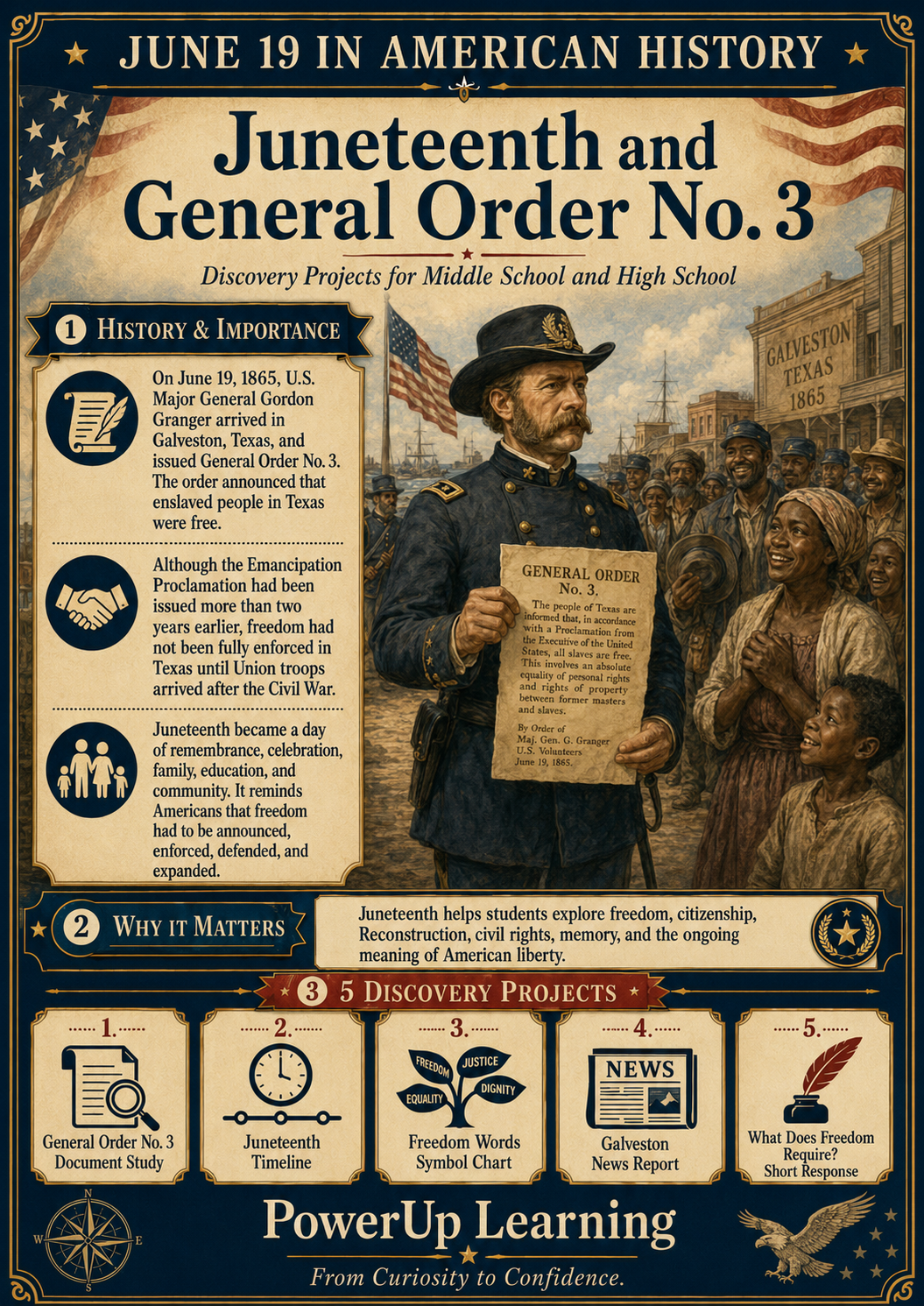
Discovery Projects
Project 1: General Order No. 3 Document Study
Project Goal:
Create a one-page document study explaining what General Order No. 3 announced and why it mattered.
What to Include:
The document study should include the date, location, person connected to the order, a short explanation of what the order said, and why the order became connected to Juneteenth. Students should also include one important phrase or idea from the order, written in their own words.
Student Directions:
Research General Order No. 3 and read a short excerpt or summary of the document. Then create a one-page document study that explains the order clearly. Students should focus on what the order announced, why it had to be enforced in Texas, and how it changed the meaning of June 19 in American history.
Final Product:
A one-page document study or annotated document page.
Reflection Question:
Why is a written order important only if people have the power and determination to enforce it?
Project 2: Juneteenth Timeline
Project Goal:
Create a timeline showing the major events that led to Juneteenth and its later recognition.
What to Include:
The timeline should include at least six events. Possible events include the Emancipation Proclamation, the Civil War, Union victory, Granger’s arrival in Galveston, General Order No. 3 on June 19, 1865, early Juneteenth celebrations, the Thirteenth Amendment, and Juneteenth becoming a federal holiday.
Student Directions:
Research the major events connected to emancipation and Juneteenth. Put the events in chronological order. For each event, write one or two sentences explaining what happened. Add small drawings, printed images, or icons to make the timeline visually clear.
Final Product:
A paper or digital timeline.
Reflection Question:
What does the timeline show about the difference between declaring freedom and making freedom real?
Project 3: Freedom Words Symbol Chart
Project Goal:
Create a chart explaining important words connected to Juneteenth.
What to Include:
Choose at least five important words. Possible words include emancipation, freedom, citizenship, Reconstruction, liberty, rights, community, remembrance, and equality.
For each word, include:
The word
A student-friendly definition
A small drawing, icon, or symbol
One sentence explaining how the word connects to Juneteenth
Student Directions:
Begin by choosing words that help explain the meaning of Juneteenth. Define each word in your own language. Then connect each word to the history of June 19, 1865. The goal is to show that Juneteenth is not only about one date, but also about larger ideas in American history.
Final Product:
An illustrated vocabulary and symbol chart.
Reflection Question:
Which word best explains the importance of Juneteenth? Why?
Project 4: Galveston News Report
Project Goal:
Write a short newspaper report about the announcement of General Order No. 3 in Galveston, Texas.
What to Include:
The news report should include a headline, date, location, opening paragraph, important facts, and one short quotation-style sentence from a historical perspective. Students may write from the viewpoint of a newspaper reporter in 1865, but the report should be historically accurate.
Student Directions:
Research what happened in Galveston on June 19, 1865. Then write a newspaper-style article explaining the announcement of freedom in Texas. The report should answer who, what, when, where, why, and how. Students should avoid modern slang and try to write in a clear, formal news style.
Final Product:
A one-page historical newspaper report.
Reflection Question:
How might different people in Galveston have reacted to the announcement of General Order No. 3?
Project 5: What Does Freedom Require? Short Response Project
Project Goal:
Write a short response explaining what Juneteenth teaches about freedom and responsibility.
What to Include:
The response should explain what happened on June 19, 1865, why the day became important, and what Juneteenth teaches about the meaning of freedom. Students should include at least one historical fact about General Order No. 3, Texas, the Civil War, or emancipation.
Student Directions:
Begin by listing words connected to Juneteenth, such as freedom, justice, law, community, equality, citizenship, and remembrance. Then choose two or three ideas to explain in writing. Students should connect historical facts to the larger question: What does freedom require?
Middle school students may write 2–3 paragraphs. High school students may write 4–5 paragraphs and include more historical evidence.
Final Product:
A short written response or essay.
Reflection Question:
Is freedom complete when it is announced, or does it require continued action? Explain your answer.
Student Project Tips
Students should begin by reading about Juneteenth, General Order No. 3, and the end of slavery in Texas. They should take notes and choose the project format that best fits their strengths. Some students may prefer creating a timeline or symbol chart, while others may prefer writing a newspaper report, studying a document, or reflecting on the meaning of freedom.
Before beginning, students should ask:
What is the main question I am answering?
What information do I need to find?
What final product will I create?
How will I show what I learned?
When the project is finished, students should review their work and make sure it is accurate, organized, respectful, and clear. Each project should help the student understand why June 19, 1865, became one of the most meaningful dates in American history.