June 26: John F. Kennedy and the “Ich bin ein Berliner” Speech
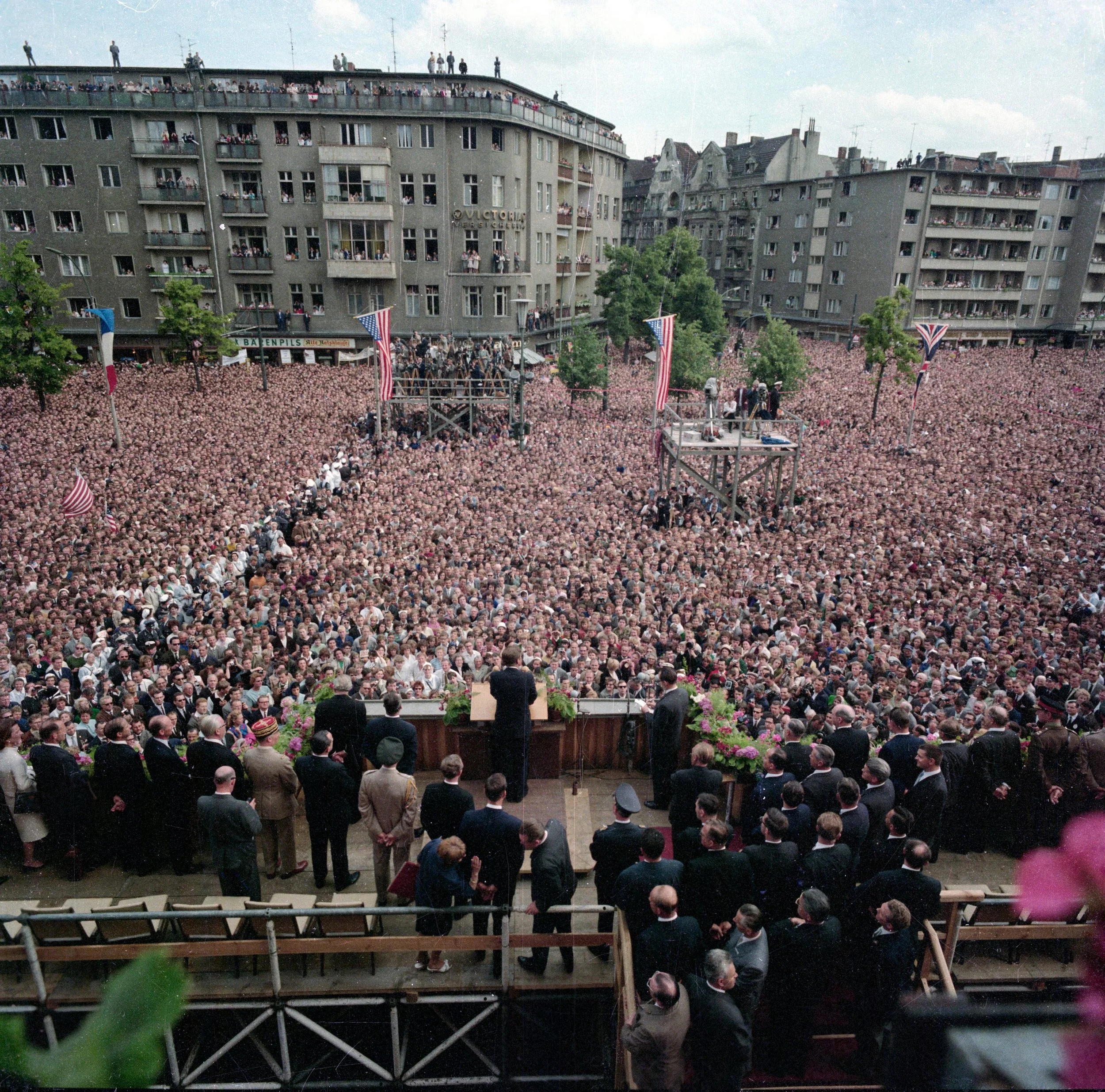
Kennedy delivering his speech in Berlin, June 26, 1953
On June 26, 1963, President John F. Kennedy stood before a large crowd in West Berlin and delivered one of the most famous speeches of the Cold War. The city of Berlin had become a powerful symbol of the conflict between democracy and communism. After World War II, Berlin was divided into zones controlled by the United States, Great Britain, France, and the Soviet Union. By 1961, the East German government, backed by the Soviet Union, had built the Berlin Wall to separate East Berlin from West Berlin and to stop people from fleeing to the West.
Kennedy’s visit came at a tense moment. West Berlin was surrounded by communist East Germany, and many people feared that the United States might eventually abandon the city. Kennedy used his speech to reassure West Berliners that the United States stood with them. Speaking at Rudolph Wilde Platz in Berlin, he praised the courage of the city’s people and explained that Berlin represented the larger struggle for freedom during the Cold War.
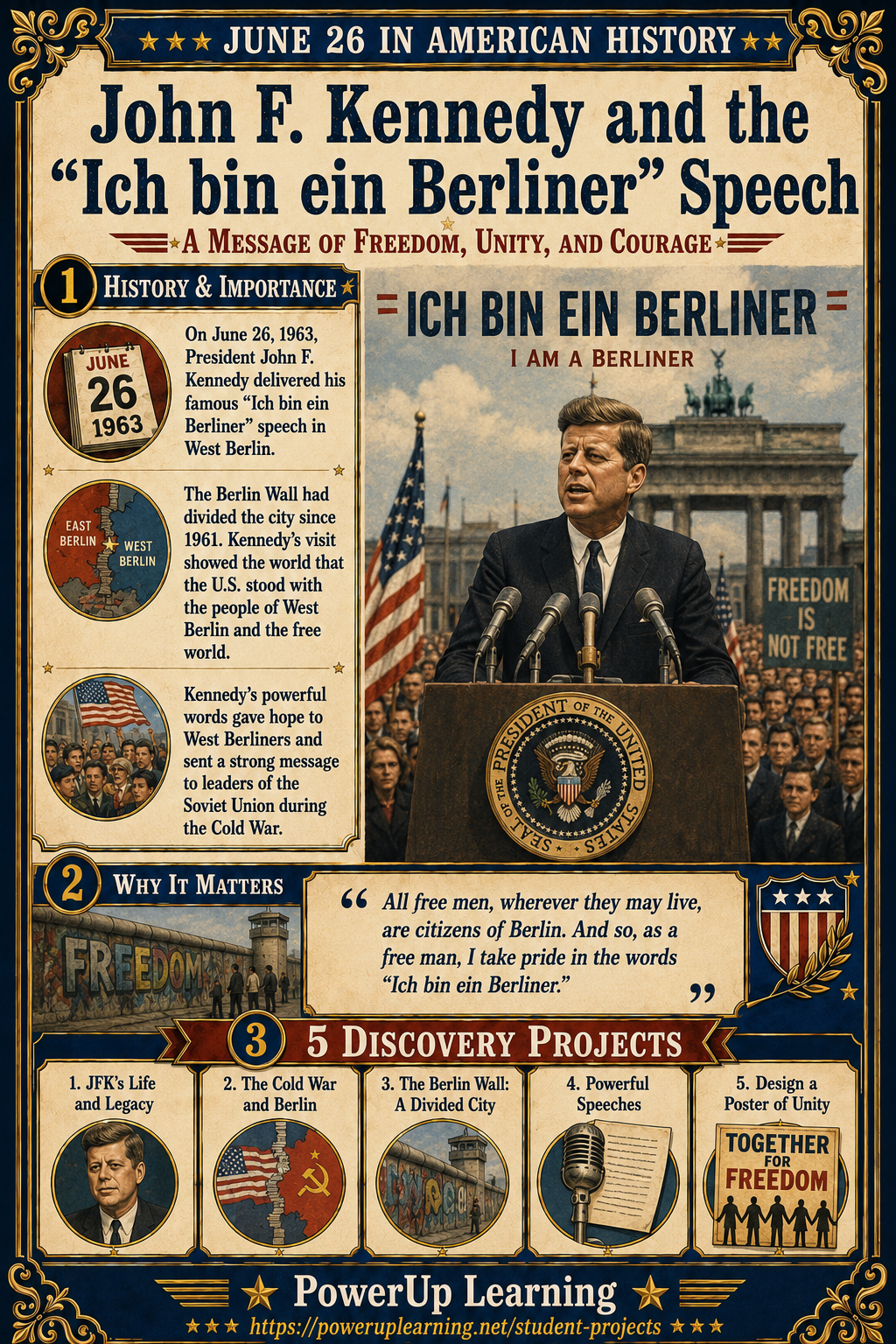
The most famous line of the speech was “Ich bin ein Berliner,” which means “I am a Berliner.” Kennedy used those words to show solidarity with people living in a divided city. His speech mattered because it connected American leadership with the defense of democracy, freedom, and international alliances. For students, this moment helps explain why the Cold War was not only fought with armies and weapons, but also with speeches, symbols, ideas, and promises.
Why It Matters
Kennedy’s Berlin speech helps students explore the Cold War, presidential leadership, geography, communication, democracy, and the power of words. It raises important historical questions: Why did Berlin become such an important Cold War symbol? How can a speech strengthen an alliance? Why do leaders use public words to send messages to both friends and enemies?
Discovery Projects
Project 1: Cold War Berlin Map Challenge
Project Goal:
Create a map that explains why Berlin was so important during the Cold War.
What to Include:
The map should show Germany, East Germany, West Germany, East Berlin, West Berlin, the Berlin Wall, and the distance between West Berlin and West Germany. Students should also label the countries or powers connected to the Cold War division: the United States, Great Britain, France, and the Soviet Union.
Student Directions:
Research how Germany and Berlin were divided after World War II. Then create a map that helps someone understand why West Berlin was unusual: it was a democratic city surrounded by communist-controlled territory. Add labels, arrows, and a short explanation of why the city became a symbol of freedom and tension.
Final Product:
A labeled paper or digital map.
Reflection Question:
Why did geography make West Berlin one of the most important places in the Cold War?
Project 2: “Ich bin ein Berliner” Speech Analysis
Project Goal:
Analyze Kennedy’s speech and explain how his words communicated support for West Berlin.
What to Include:
Students should choose three short excerpts or key ideas from Kennedy’s speech. For each one, they should explain what Kennedy meant, why the words were powerful, and how the audience might have responded.
Student Directions:
Read or listen to part of Kennedy’s June 26, 1963 speech. Look for words connected to freedom, democracy, courage, unity, and responsibility. Create a speech analysis chart with three columns: Kennedy’s Words, What They Mean, and Why They Mattered.
Final Product:
A speech analysis chart.
Reflection Question:
How can one sentence or phrase become a powerful symbol in history?
Project 3: Presidential Leadership Poster
Project Goal:
Create a poster showing how Kennedy used leadership during the Cold War.
What to Include:
The poster should include Kennedy’s name, the date June 26, 1963, the phrase “Ich bin ein Berliner,” and a short explanation of why the speech mattered. Students should also include at least three leadership traits Kennedy showed during this event, such as courage, communication, confidence, diplomacy, or commitment.
Student Directions:
Research Kennedy’s visit to West Berlin and the situation created by the Berlin Wall. Then design a poster that teaches others how a president can use words, symbolism, and public appearance to reassure allies and challenge opponents.
Final Product:
An illustrated educational poster.
Reflection Question:
What leadership trait was most important in Kennedy’s Berlin speech? Why?
Project 4: Freedom and the Berlin Wall Timeline
Project Goal:
Create a timeline showing major events connected to Berlin during the Cold War.
What to Include:
The timeline should include at least six events. Possible events include the end of World War II, the division of Germany, the Berlin Blockade and Airlift, the building of the Berlin Wall in 1961, Kennedy’s speech on June 26, 1963, and the fall of the Berlin Wall in 1989.
Student Directions:
Research major Berlin-related Cold War events and place them in chronological order. For each event, write one or two sentences explaining what happened and why it mattered. Add symbols, images, or color coding to show whether each event increased tension or increased hope.
Final Product:
A paper or digital timeline.
Reflection Question:
How did Berlin’s history show both the dangers of the Cold War and the hope for freedom?
Project 5: Words as Weapons in the Cold War
Project Goal:
Investigate how speeches, slogans, symbols, and public messages were used during the Cold War.
What to Include:
Students should explain how words could influence people during a conflict between political systems. They may compare Kennedy’s “Ich bin ein Berliner” speech with another Cold War message, such as a presidential speech, a newspaper headline, a propaganda poster, or a political cartoon.
Student Directions:
Choose one Cold War speech, slogan, poster, or public message to compare with Kennedy’s Berlin speech. Identify the main message, the audience, and the goal. Then explain how communication became part of the Cold War struggle.
Final Product:
A comparison chart, short report, or slide presentation.
Reflection Question:
Why were speeches and symbols so important during the Cold War?
Student Project Tips
Students should begin by learning why Berlin was divided, why the Berlin Wall was built, and why West Berlin became a symbol of freedom during the Cold War. This topic works well for students interested in geography, government, presidential speeches, international relations, world history, communication, and political symbolism.
Before beginning, students should ask:
What happened in Berlin on June 26, 1963?
Why was West Berlin important to the United States?
What did Kennedy mean when he said, “Ich bin ein Berliner”?
How did the Berlin Wall represent the Cold War?
How can a speech change the way people understand a historical moment?