June 27: Helen Keller and the Power of Communication

Helen Keller and Anne Sullivan, July 1888 | public domain
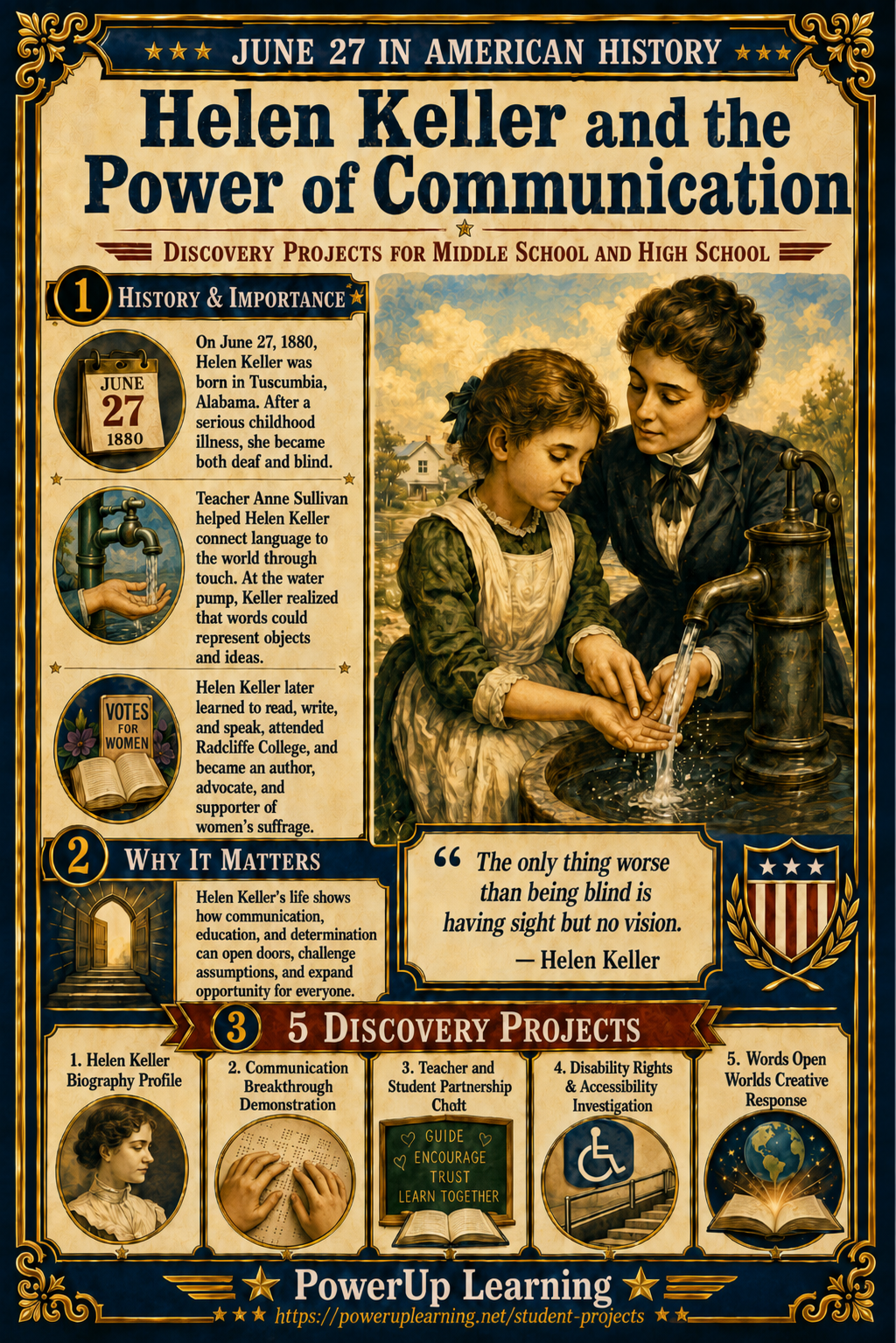
On June 27, 1880, Helen Keller was born in Tuscumbia, Alabama. As a young child, Keller became both deaf and blind after a serious illness. Because she could not hear spoken words or see the world around her, communication became extremely difficult. Her early childhood was marked by frustration because she had thoughts, needs, and feelings but did not yet have a clear way to express them. Her life changed when teacher Anne Sullivan arrived and began helping Keller connect language to the world through touch.
One of the most famous moments in Keller’s life happened when Sullivan spelled the word “water” into Keller’s hand while water flowed over her other hand. That moment helped Keller understand that words could represent real objects and ideas. From there, she learned rapidly. Keller eventually learned to read, write, speak, and use several forms of communication. She later attended Radcliffe College, becoming the first deafblind person to earn a Bachelor of Arts degree. Her educational success challenged the belief that people with disabilities could not participate fully in academic and public life.
Helen Keller was an active supporter of the women’s suffrage movement and believed that voting rights were necessary for women to have a stronger voice in public life. She argued that women should have the same political rights as men because laws, education, labor conditions, poverty, and social reform all affected women directly. Keller’s support for suffrage was part of her broader commitment to justice and equality. She did not limit her advocacy to disability rights; she also spoke out for workers, women, and people who were excluded from full participation in society. Her involvement in the suffrage movement showed that she understood voting as a tool for change, giving women the power to influence government decisions and help shape a more fair and democratic nation.
Why It Matters
Heleeller raises important historical questions: How do people communicate in different ways? Why does access to education matter? How can one person’s achievements change public attitudes? What role do teachers, families, and communities play in helping students succeed?
Discovery Projects
Project 1: Helen Keller Biography Profile
Project Goal:
Create a one-page biography profile about Helen Keller and her impact on American history.
What to Include:
The profile should include Keller’s name, birth date, birthplace, childhood illness, relationship with Anne Sullivan, educational achievements, and work as an author and advocate. Students should explain why Keller became an important figure in education and disability history.
Student Directions:
Research Helen Keller’s life and take notes about her childhood, communication breakthrough, education, public speaking, writing, and advocacy. Then create a biography profile that teaches others why her story matters in American history.
Final Product:
A one-page illustrated biography profile.
Reflection Question:
Why was Helen Keller’s ability to communicate such an important turning point in her life?
Project 2: Communication Breakthrough Demonstration
Project Goal:
Explore how communication can happen through touch, symbols, movement, and language.
What to Include:
Students should explain how Anne Sullivan helped Helen Keller connect words to objects and ideas. The project should include at least three forms of communication, such as spoken language, written language, sign language, tactile spelling, Braille, gestures, images, or symbols.
Student Directions:
Choose three different ways people communicate. Create a demonstration or display that shows how each method works. Then explain why having access to communication is important for learning, relationships, independence, and self-expression.
Final Product:
A demonstration, poster, slide presentation, or communication chart.
Reflection Question:
How would daily life change if you could not use your usual way of communicating?
Project 3: Teacher and Student Partnership Chart
Project Goal:
Create a chart showing how Helen Keller and Anne Sullivan worked together as learner and teacher.
What to Include:
The chart should include challenges Keller faced, strategies Sullivan used, and examples of Keller’s progress. Students should explain how patience, trust, creativity, and persistence helped both teacher and student succeed.
Student Directions:
Research the relationship between Helen Keller and Anne Sullivan. Then create a two-column or three-column chart showing the problem, the teaching strategy, and the result. Use specific examples from Keller’s life.
Final Product:
A partnership chart or cause-and-effect organizer.
Reflection Question:
What qualities make a teacher or mentor especially important in a student’s life?
Project 4: Disability Rights and Accessibility Investigation
Project Goal:
Investigate how Helen Keller’s life connects to accessibility and disability rights.
What to Include:
Students should define accessibility and explain why it matters. They may investigate tools and supports such as Braille books, ramps, captions, screen readers, service animals, interpreters, audiobooks, or assistive technology. Students should connect these supports to the larger idea that people should have equal access to learning and community life.
Student Directions:
Choose one accessibility tool or support and research how it helps people participate more fully in school, work, or public life. Then explain how Keller’s advocacy helped people think more seriously about opportunity and inclusion.
Final Product:
An informational poster, short report, or accessibility design proposal.
Reflection Question:
Why is accessibility not just helpful, but necessary for fairness and participation?
Project 5: “Words Open Worlds” Creative Response
Project Goal:
Create a written or artistic response showing how language and learning changed Helen Keller’s life.
What to Include:
Students should include the date June 27, 1880, the phrase Today in American History, and at least three important words connected to Keller’s life, such as communication, education, perseverance, advocacy, accessibility, or opportunity.
Student Directions:
Create a poem, short essay, poster, illustrated quote page, or spoken reflection about the idea that “words open worlds.” Use Helen Keller’s life as the historical example. Explain how communication helped Keller learn, connect with others, and become an advocate.
Final Product:
A creative written or visual response.
Reflection Question:
How can words, signs, or symbols change what a person is able to learn and share?
Student Project Tips
Students should begin by learning about Helen Keller’s childhood, Anne Sullivan’s teaching, Keller’s education, and her later work as a writer and advocate. This topic works well for students interested in biography, special education, communication, disability rights, language, writing, teaching, and social change.
Before beginning, students should ask:
What happened on June 27, 1880?
How did Helen Keller learn to communicate?
Why was Anne Sullivan important in Keller’s life?
How did Keller’s education challenge public expectations?
How can accessibility help people participate more fully in society?