June 25: The Korean War Begins


.jpg)
.jpg)

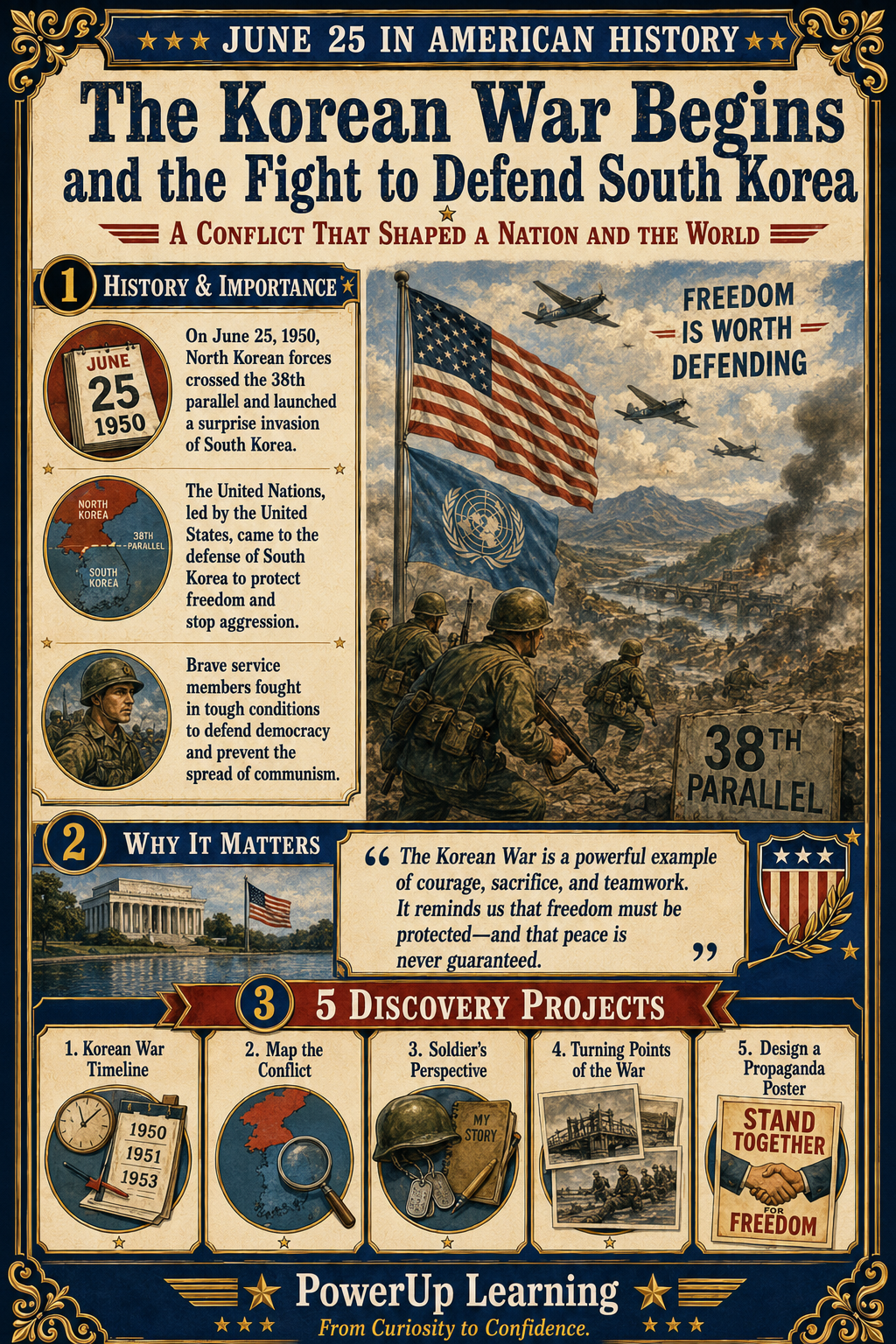
On June 25, 1950, North Korean forces crossed the 38th parallel and invaded South Korea, beginning the Korean War. The 38th parallel had divided the Korean Peninsula after World War II, with a communist government in the North supported by the Soviet Union and a non-communist Republic of Korea in the South supported by the United States. The invasion quickly became one of the first major military crises of the Cold War.
The United States and the United Nations faced a major decision. If North Korea succeeded in taking over South Korea, it could change the balance of power in Asia and signal that military aggression would go unanswered. The United Nations condemned the invasion, and the United States soon became the leading military power in the effort to defend South Korea. The war became a United Nations conflict, with forces from many countries serving under a unified command led by the United States.
The Korean War lasted until 1953, when an armistice stopped the fighting but did not create a formal peace treaty. Because of this, the Korean Peninsula remained divided, and the Korean Demilitarized Zone became one of the most heavily guarded borders in the world. For students, the Korean War is important because it shows how the Cold War shaped American foreign policy, military decisions, international alliances, and the lives of soldiers and civilians. It is sometimes called the “Forgotten War,” but its consequences are still visible today.
Why It Matters
The beginning of the Korean War helps students understand how American history connects to Cold War politics, world geography, military alliances, and international responsibility. It raises important questions about how nations respond to aggression, why the United States became involved in conflicts far from home, and how one war can shape global politics for generations. Students can also explore the human side of the war by studying soldiers, refugees, divided families, veterans, and civilians caught in the conflict.
Discovery Projects
Project 1: Korean War Map Challenge
Project Goal:
Create a map that explains why Korea’s location and division mattered in 1950.
What to Include:
The map should show North Korea, South Korea, the 38th parallel, Seoul, Pyongyang, China, Japan, and nearby bodies of water. Students should label where North Korean forces crossed into South Korea and explain why the geography of the Korean Peninsula made the conflict important.
Student Directions:
Research the Korean Peninsula and its location in East Asia. Then create a labeled map that shows the division between North and South Korea. Add arrows showing the direction of the North Korean invasion. Include a short explanation of why the 38th parallel became historically important.
Final Product:
A labeled paper or digital map.
Reflection Question:
Why did geography make the Korean War important to the United States and the world?
Project 2: Cold War Decision Chart
Project Goal:
Analyze the choices facing the United States and the United Nations after North Korea invaded South Korea.
What to Include:
Students should create a chart with at least three possible responses:
Do not intervene militarily.
Send supplies and financial support only.
Send military forces through the United Nations.
For each option, students should explain the possible benefits, risks, and consequences.
Student Directions:
Imagine you are advising President Harry S. Truman in June 1950. Study the situation and create a decision chart that explains what choices the United States had after the invasion. Use evidence from the event to explain why each choice would have been difficult.
Final Product:
A decision chart or policy recommendation page.
Reflection Question:
Why was the decision to defend South Korea such an important Cold War turning point?
Project 3: The Human Cost of War Profile
Project Goal:
Create a profile that explores how the Korean War affected soldiers, civilians, or families.
What to Include:
Students may focus on an American soldier, a Korean civilian, a refugee family, a nurse, a pilot, or a United Nations service member. The profile should explain who the person was, what challenges they faced, and how the war changed their life.
Student Directions:
Research one person or group connected to the Korean War. Look for details about daily life, danger, sacrifice, service, displacement, or survival. Then create a profile that helps others understand the human side of the conflict.
Final Product:
A one-page illustrated historical profile.
Reflection Question:
Why is it important to study the experiences of ordinary people during war?
Project 4: “Forgotten War” Investigation
Project Goal:
Investigate why the Korean War is sometimes called the “Forgotten War.”
What to Include:
Students should compare the Korean War with World War II and the Vietnam War. They should look at how each war is remembered in books, films, memorials, public discussion, and school history lessons.
Student Directions:
Research why the Korean War receives less attention than some other American wars. Then create a short investigation report explaining whether the phrase “Forgotten War” is accurate or unfair. Include at least three reasons to support your conclusion.
Final Product:
A short report, slide presentation, or comparison chart.
Reflection Question:
What makes some historical events easier to remember than others?
Project 5: Korean War Educational Poster
Project Goal:
Design a poster that teaches others why June 25, 1950, matters in American history.
What to Include:
The poster should include the date June 25, 1950, the phrase Today in American History, and the words Korean War, 38th parallel, South Korea, North Korea, United Nations, and Cold War. Students should also include a short explanation of why the invasion became a major historical event.
Student Directions:
Use strong visuals such as a map, divided peninsula, soldiers, civilians, flags, newspaper headlines, or a timeline. Keep the poster clear and historically accurate. The goal is to help someone understand what happened, why the United States became involved, and why the war still matters.
Final Product:
An educational poster.
Reflection Question:
What image or symbol best represents the beginning of the Korean War? Why?
Student Project Tips
Students should begin by learning where Korea is located, why it was divided after World War II, and how the Cold War shaped the choices made by the United States and the United Nations. This topic works well for students interested in geography, military history, diplomacy, international relations, veterans’ stories, maps, political decision-making, and the long-term effects of war.
Before beginning, students should ask:
What happened on June 25, 1950?
Why was Korea divided at the 38th parallel?
Why did the United States and the United Nations respond?
How did the war affect soldiers and civilians?
Why is the Korean War still important today?