June 24: The Berlin Blockade and the Airlift That Fed a City

Berliners watching a C-54 land at Berlin Tempelhof Airport, 1948 | Library of Congress
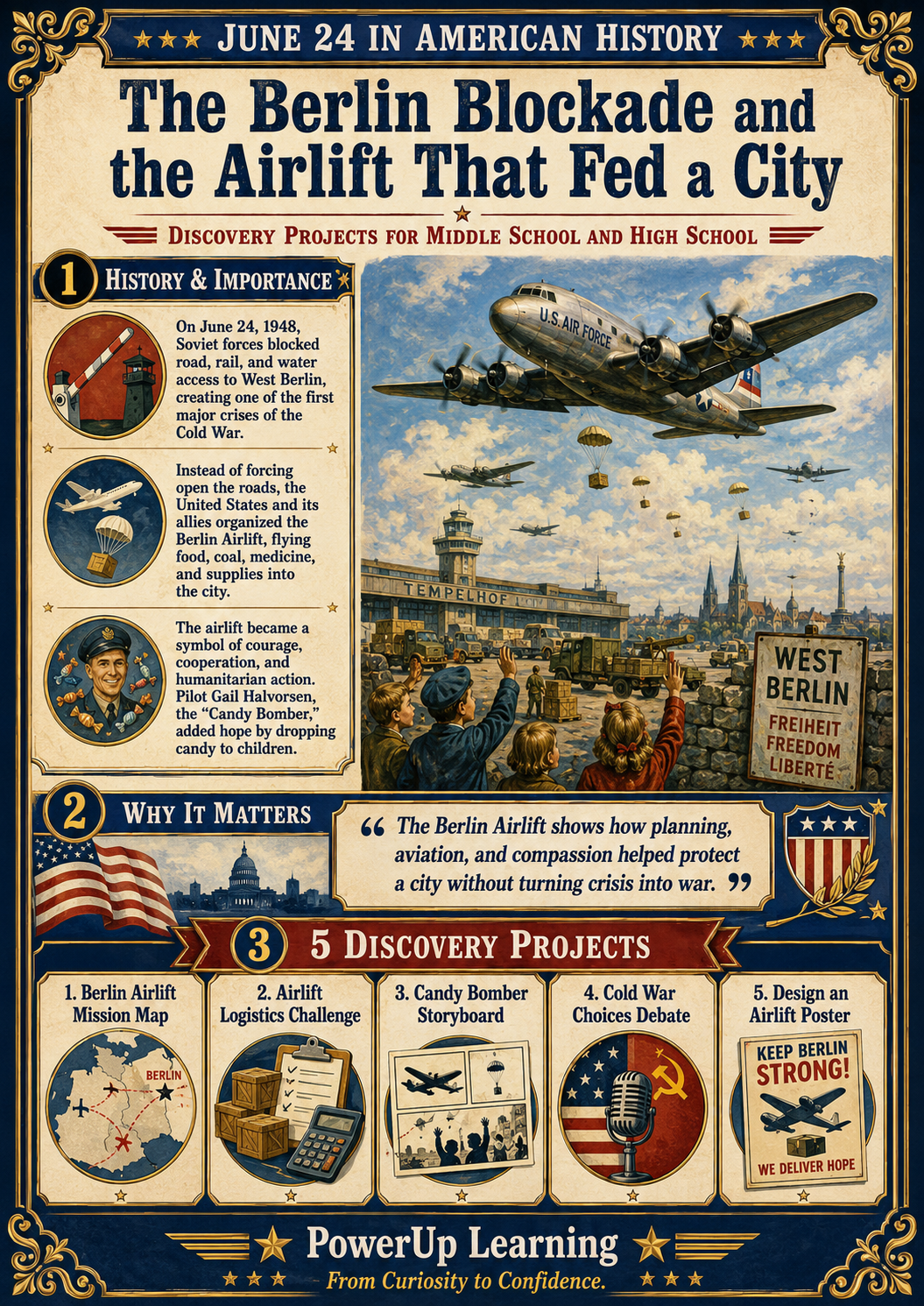
On June 24, 1948, Soviet forces blocked road, rail, and water access to West Berlin, cutting off the city from supplies coming from the western zones of Germany. West Berlin was located deep inside Soviet-controlled territory, but it was still occupied by the United States, Great Britain, and France after World War II. The blockade created one of the first major crises of the Cold War because nearly two million people in West Berlin depended on outside supplies for food, fuel, medicine, and basic survival.
President Harry S. Truman and the Western Allies faced a difficult choice. They could abandon West Berlin, try to force their way through Soviet-controlled roads, or find another way to keep the city alive. Instead of starting a direct military confrontation, the United States and Britain organized an airlift to fly supplies into West Berlin. The mission became known as the Berlin Airlift, and it showed that aircraft could be used not only in war, but also to protect people through planning, courage, and cooperation.
The airlift became a massive logistical challenge. Planes had to deliver food, coal, medicine, and other supplies day after day, in all kinds of weather. Pilots, mechanics, ground crews, air traffic controllers, and planners worked together to keep the operation moving. The crisis lasted until May 1949, when the Soviet Union lifted the blockade, but the airlift continued for several more months to build up supplies.
One of the most student-friendly stories from the Berlin Airlift is that of American pilot Gail Halvorsen, who became known as the “Candy Bomber.” After meeting children near Tempelhof Airport, Halvorsen began dropping small parachutes carrying candy to children in Berlin. His act of kindness became known as Operation Little Vittles and turned a military supply mission into a symbol of hope for children living through a tense and frightening Cold War crisis.
Why It Matters
The Berlin Airlift helps students understand how American history connects to world history after World War II. It shows how the Cold War was not only about weapons and threats, but also about choices, values, strategy, and humanitarian responsibility. Students can explore how the United States used planning, technology, aviation, diplomacy, and public resolve to respond to a crisis without immediately turning it into a shooting war.
Discovery Projects
Project 1: Berlin Airlift Mission Map
Project Goal:
Create a map that explains why West Berlin was difficult to supply during the blockade.
What to Include:
The map should show Germany after World War II, the Soviet zone, West Berlin, the Western zones, and the air corridors used to reach the city. Students should label the blockade and explain why planes became essential.
Student Directions:
Research the location of Berlin after World War II. Then create a map showing how West Berlin was surrounded by Soviet-controlled territory. Add arrows to show how supplies had to be flown into the city.
Final Product:
A labeled paper or digital map.
Reflection Question:
Why did geography make the Berlin Blockade such a serious crisis?
Project 2: Airlift Logistics Challenge
Project Goal:
Design a supply plan for feeding and supporting a blockaded city.
What to Include:
Students should identify at least five types of supplies West Berlin needed, such as food, coal, medicine, clothing, and fuel. They should explain how transportation, timing, weather, and teamwork would affect the mission.
Student Directions:
Imagine you are part of the planning team for the Berlin Airlift. Create a chart showing what supplies must be delivered, why each item matters, and what problems might make delivery difficult.
Final Product:
A logistics chart or mission planning board.

1st Lt. Gail Halvorsen and the 17th Military Air Transport Squadron rig some candy bars to miniature parachutes for German children in Berlin as part of Operation Little Vittles.
Reflection Question:
What was the hardest part of keeping West Berlin supplied by air?
Project 3: The Candy Bomber Storyboard
Project Goal:
Create a storyboard that tells the story of Gail Halvorsen and Operation Little Vittles.
What to Include:
The storyboard should include Halvorsen meeting children near the airport, deciding to help, making small parachutes, dropping candy, and becoming known as the Candy Bomber.
Student Directions:
Research Gail Halvorsen’s role in the Berlin Airlift. Then draw or digitally create a 6-panel storyboard that shows how one small act of kindness became part of a major Cold War story.
Final Product:
A 6-panel illustrated storyboard.
Reflection Question:
How can a small act of kindness become historically meaningful?
Project 4: Cold War Choices Debate
Project Goal:
Hold a debate about what the United States should have done during the Berlin Blockade.
What to Include:
Students should consider three possible choices: leave West Berlin, force open the roads, or supply the city by air. Each group should explain the risks and benefits of its assigned option.
Student Directions:
Work in teams. Each team will represent one possible response to the blockade. Use historical evidence to argue why your option might have seemed reasonable in 1948. After the debate, compare your arguments with what the United States and its allies actually did.
Final Product:
A class debate or written position statement.
Reflection Question:
Why was the airlift a powerful alternative to direct military conflict?
Project 5: Design an Airlift Poster
Project Goal:
Create a poster that teaches others why the Berlin Airlift mattered.
What to Include:
The poster should include the date June 24, 1948, the phrase Today in American History, the words Berlin Blockade, Berlin Airlift, and Operation Vittles, plus a short explanation of why the airlift became a symbol of courage and cooperation.
Student Directions:
Use strong visuals such as planes, supply crates, maps, parachutes, or city skylines. Keep the message clear: the Berlin Airlift was a major Cold War event and a humanitarian mission.
Final Product:
An educational poster.
Reflection Question:
What image or symbol best represents the Berlin Airlift? Why?
Student Project Tips
Students should begin by learning what happened in Berlin after World War II and why the city became a Cold War flashpoint. They should pay attention to geography, technology, leadership, and human need. This topic works well for students who enjoy aviation, maps, strategy, engineering, world history, humanitarian stories, or Cold War drama.
Before beginning, students should ask:
What problem did the Berlin Blockade create?
Why did the United States and its allies choose an airlift?
What supplies did West Berlin need to survive?
How did the Candy Bomber story add a human side to the crisis?
What does this event show about courage, planning, and cooperation?