May 28: Indian Removal Act of 1830
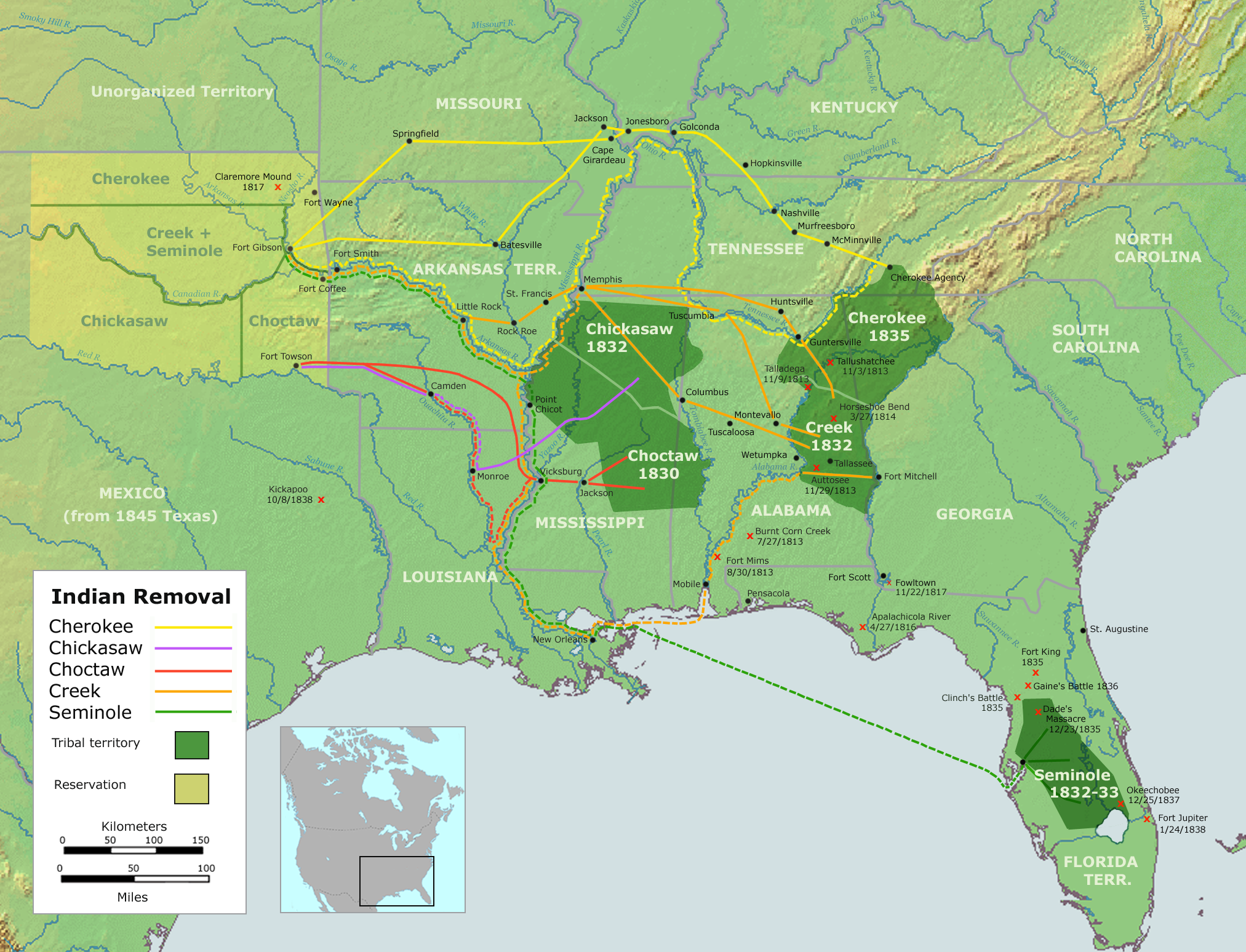
Source: User:Nikater, Public domain, via Wikimedia Commons
On May 28, 1830, President Andrew Jackson signed the Indian Removal Act into law. The Indian Removal Act of 1830 gave the president authority to negotiate treaties that would move Native nations living east of the Mississippi River to lands west of the river. In practice, the law helped the federal government pressure Native nations to give up ancestral homelands in the Southeast, including land in Georgia, Alabama, Mississippi, Tennessee, North Carolina, and surrounding areas. The Act especially affected the Cherokee, Muscogee Creek, Choctaw, Chickasaw, and Seminole nations. The National Archives explains that the law’s goal was to remove American Indians from existing states and territories and send them westward.
The consequences were devastating. Removal broke up communities, separated families from ancestral lands, disrupted tribal governments, and caused enormous suffering during forced migrations. The Cherokee removal became known as the Trail of Tears, but many Native nations experienced forced displacement, hunger, disease, exposure, and death. The National Museum of the American Indian notes that many Americans opposed removal at the time, including citizens, newspaper writers, lawmakers, and Native leaders, because they viewed it as a violation of justice and treaty promises.
The Act also had major educational consequences. Native children and families lost access to community-based learning tied to language, land, oral tradition, family responsibilities, farming, diplomacy, spiritual life, and tribal governance. Forced removal weakened the places where cultural knowledge was passed from one generation to the next. Later in the nineteenth and twentieth centuries, federal assimilation policies went even further through government- and church-operated boarding schools, where many Native children were forbidden to speak their languages and were separated from their families and cultures.
For students, the Indian Removal Act is important because it shows that education is not limited to classrooms. Education also includes language, culture, land, family memory, and community identity. When Native nations were removed from their homelands, the United States did not only take land; it also damaged systems of knowledge that had existed for generations. Studying the Act today helps students understand tribal sovereignty, treaty rights, historical injustice, and the importance of including Indigenous perspectives in American history.
Student Project: The Indian Removal Act and the Disruption of Native Communities
Project Goal
Students will examine the Indian Removal Act of 1830 and explain how it affected Native nations, families, land, culture, education, and community life. Students will learn that the consequences of removal were not only political and geographic, but also deeply human, cultural, and educational.
Project Description
In this project, students will research the Indian Removal Act and its consequences for Native nations such as the Cherokee, Choctaw, Chickasaw, Muscogee Creek, and Seminole. Students will investigate why the United States government supported removal, how Native leaders and communities responded, and what happened during forced relocation.
Students should pay special attention to how removal affected Native children and families. The project should explore how losing ancestral homelands disrupted traditional forms of learning, including language, oral history, cultural practices, farming knowledge, spiritual traditions, and community responsibilities. Students should also consider how this history connects to later federal policies, including Native boarding schools and assimilation efforts.
The project should help students understand that education is broader than classroom instruction. For Native communities, education included the passing down of knowledge through family, elders, land, language, and cultural practice. Forced removal damaged those systems of learning and created long-term consequences that are still important to understand today.
Research Questions
Students should use these questions to guide their research:
What was the Indian Removal Act of 1830, and what did it allow the federal government to do?
Which Native nations were most affected by the Act?
Why did President Andrew Jackson and many U.S. leaders support Indian removal?
How did Native leaders and communities resist removal?
What happened during forced relocations such as the Trail of Tears?
How did removal affect Native families, children, languages, and cultural traditions?
In what ways did removal disrupt Native systems of education and community learning?
How should students today remember and study the consequences of the Indian Removal Act?
Final Project Options
Option 1: Historical Cause-and-Effect Poster
Students create a poster showing the causes and consequences of the Indian Removal Act. The poster should include one section explaining why the Act was passed, one section showing how Native nations were affected, and one section explaining the long-term consequences for land, culture, and education.
Final product: A visual poster with headings, short explanations, images or symbols, and a brief written reflection.
Option 2: Native Community Impact Map
Students create a map showing the homelands of one Native nation before removal and the area where many members of that nation were forced to relocate. The map should include arrows, labels, dates, and short notes explaining what was lost during removal, including land, homes, schools, farms, sacred places, language communities, and systems of cultural learning.
Final product: A labeled historical map with a written explanation of at least two paragraphs.
Option 3: First-Person Historical Journal
Students write a series of journal entries from the point of view of a Native child, parent, teacher, or community member affected by removal. The entries should be historically respectful and based on research. Students should describe the emotional, physical, cultural, and educational impact of being forced from ancestral land.
Final product: Three to five journal entries with a short author’s note explaining the historical facts used.
Option 4: Research Presentation
Students prepare a short presentation explaining how the Indian Removal Act affected one Native nation. The presentation should include background information, key events, consequences of removal, and a final section on how removal disrupted learning, language, and cultural knowledge.
Final product: A 5–7 slide presentation or oral report with visuals and a Works Cited page.