June 1: Don’t Give Up the Ship!
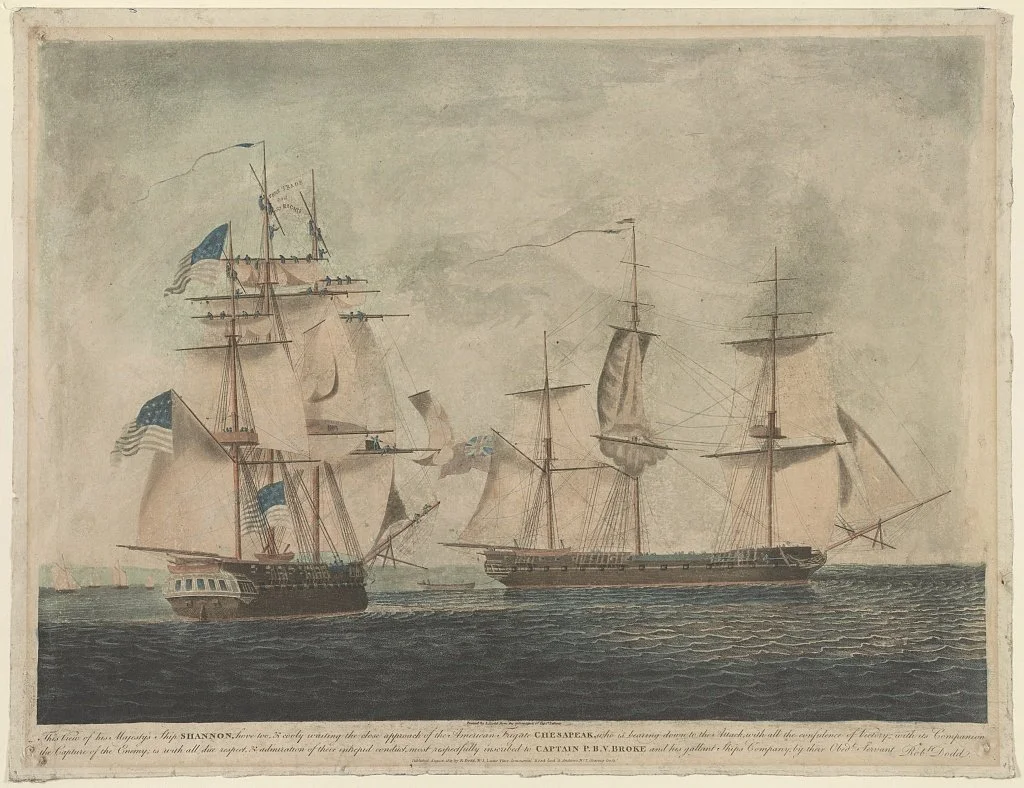
Print shows the USS Chesapeake, on the left, approaching HMS Shannon, during the War of 1812. The Chesapeake is flying a flag that states "Free Trade and Sailors Rights".
Dodd, Robert, 1748-1815, artist
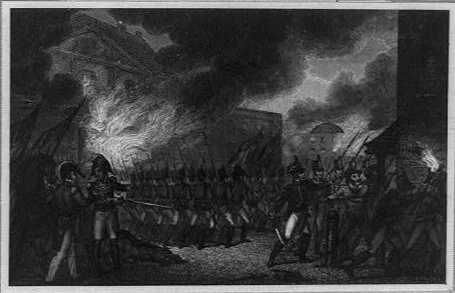
Print shows British soldiers marching into Washington, D.C. and burning buildings during the War of 1812.| Library of Congress
On June 1, 1813, the American frigate USS Chesapeake sailed out of Boston Harbor to face the British frigate HMS Shannon during the War of 1812. The battle took place at a time when the United States Navy was still young and eager to prove itself against Britain’s powerful Royal Navy. Captain James Lawrence, newly assigned to the Chesapeake, accepted the challenge from British Captain Philip Broke, who had carefully trained his crew for close combat. Although the two ships were similar in size and firepower, the Shannon had a better-prepared crew, while the Chesapeake suffered from poor discipline, recent crew changes, and confusion on board.
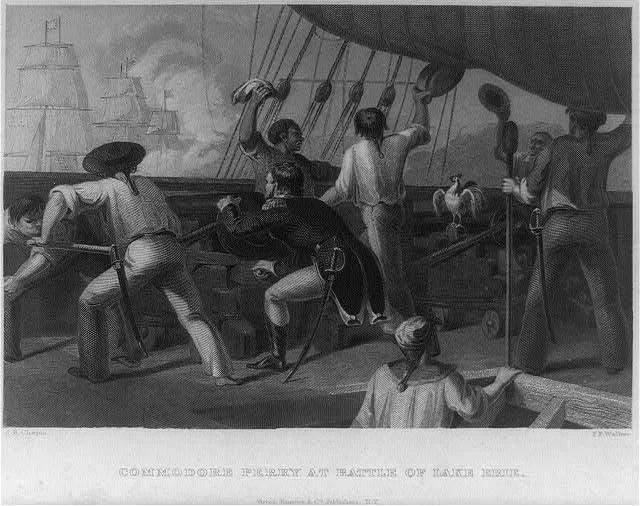
Print shows Admiral Oliver Hazard Perry behind a cannon aboard ship during the Battle of Lake Erie, with men waving hats, and a rooster perched on an unattended cannon. | Library of Congress
The fighting was extremely short but devastating. After an exchange of cannon fire, the two ships became locked together, and British sailors boarded the Chesapeake. Captain Lawrence was mortally wounded during the battle, and the American crew was quickly overwhelmed. As he was carried below deck, Lawrence reportedly gave the order, “Don’t give up the ship.” Ironically, the ship was captured soon afterward, but the phrase survived the defeat and became one of the most famous slogans in American naval history.
The battle mattered because it showed that courage alone could not overcome training, discipline, and preparation. The United States lost the Chesapeake, but Lawrence’s final words became a symbol of determination. Later that same year, Commodore Oliver Hazard Perry used the phrase on his battle flag at the Battle of Lake Erie, where the Americans won an important naval victory. In that way, a painful defeat off Boston became part of a larger story about resilience, memory, and the young nation’s effort to define its naval identity.
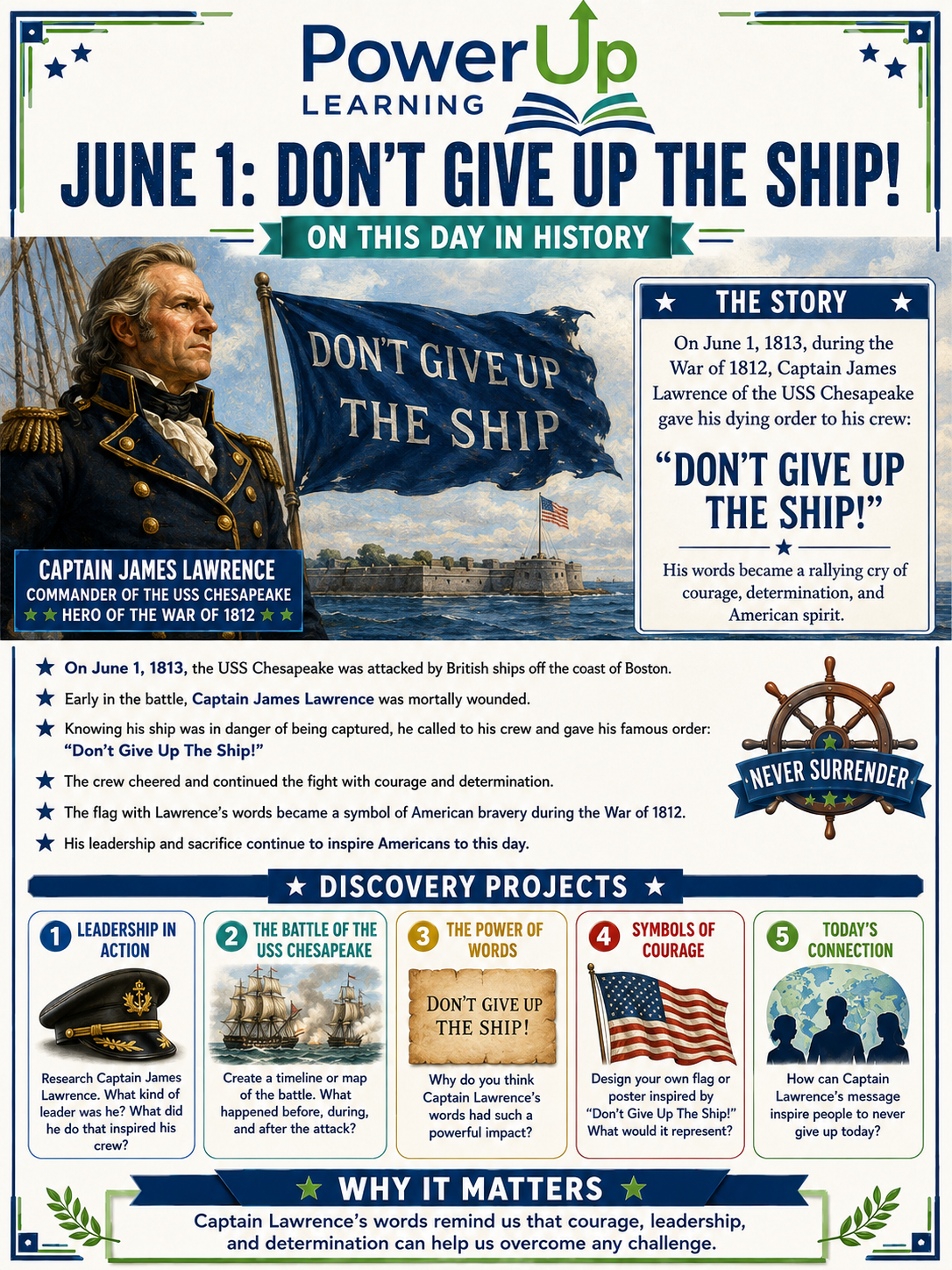
Discovery Projects
Project 1: “Don’t Give Up the Ship” — Words, Memory, and Meaning
Project Goal:
Students will examine how Captain James Lawrence’s final command, “Don’t give up the ship,” became a lasting symbol in American naval history even though the USS Chesapeake was defeated.
Project Description:
Students will research the battle between the USS Chesapeake and HMS Shannon, focusing on how a phrase spoken during defeat became part of American memory. Students will explore how historical quotes, slogans, flags, and public stories can shape national identity. They will also connect Lawrence’s words to Oliver Hazard Perry’s later use of the phrase at the Battle of Lake Erie.
Research Questions:
What happened to Captain James Lawrence during the battle?
Why did the phrase “Don’t give up the ship” become famous?
How did Oliver Hazard Perry use Lawrence’s words later in the War of 1812?
Why do some phrases become more famous than the events that produced them?
How do symbols, flags, and slogans help people remember history?
Final Project Options:
Students may create:
A historical quote analysis poster
A battle flag design with explanatory notes
A short documentary script
A museum exhibit panel
A newspaper article from 1813
A written reflection on courage, defeat, and memory
Reflection Question:
Why might a nation remember words of courage from a defeat as strongly as it remembers a military victory?
Project 2: Naval Strategy and Preparation in the War of 1812
Project Goal:
Students will analyze how training, leadership, ship readiness, and discipline affected the outcome of the battle between the USS Chesapeake and HMS Shannon.
Project Description:
Students will compare the two ships, their commanders, and their crews. They will investigate why HMS Shannon was better prepared for battle and why the USS Chesapeake struggled despite having similar firepower. Students will use the battle to explain how preparation and leadership can determine the outcome of military conflict.
Research Questions:
How were the USS Chesapeake and HMS Shannon similar?
How were the two crews different in training and readiness?
What role did Captain Philip Broke’s preparation play in the British victory?
What challenges did Captain James Lawrence face when he took command of the Chesapeake?
What does this battle teach about leadership, discipline, and military planning?
Final Project Options:
Students may create:
A ship comparison chart
A naval battle diagram
A commander profile comparing Lawrence and Broke
A cause-and-effect chart
A military briefing presentation
A short essay on preparation versus courage
Reflection Question:
What matters more in battle: bravery, preparation, leadership, or experience?
Project 3: From Defeat to Victory — Connecting the USS Chesapeake to Lake Erie
Project Goal:
Students will examine how Captain James Lawrence’s words, “Don’t give up the ship,” moved from a naval defeat in June 1813 to a symbol of American victory at the Battle of Lake Erie later that same year.
Project Description:
Students will research two connected War of 1812 events: the defeat of the USS Chesapeake by HMS Shannon on June 1, 1813, and Commodore Oliver Hazard Perry’s victory at the Battle of Lake Erie on September 10, 1813. Students will explore how Lawrence’s final command became part of Perry’s battle flag and how the phrase helped transform a moment of loss into a symbol of courage, persistence, and national identity.
Research Questions:
What happened to the USS Chesapeake on June 1, 1813?
Why did “Don’t give up the ship” become an important naval phrase?
How did Oliver Hazard Perry use Lawrence’s words at the Battle of Lake Erie?
Why was the Battle of Lake Erie important to the War of 1812?
How can a phrase, flag, or symbol connect two separate historical events?
How do nations turn difficult moments into stories of courage and unity?
Final Project Options:
Students may create:
A two-event timeline connecting June 1 and September 10, 1813
A symbolic analysis of Perry’s battle flag
A museum exhibit panel titled “From Defeat to Victory”
A short documentary script about Lawrence and Perry
A compare-and-contrast chart of the two naval battles
A historical newspaper feature explaining how Lawrence’s words inspired Perry’s victory
Reflection Question:
How can the memory of a defeat inspire later courage, action, or victory?Applicable Common Core State Standards