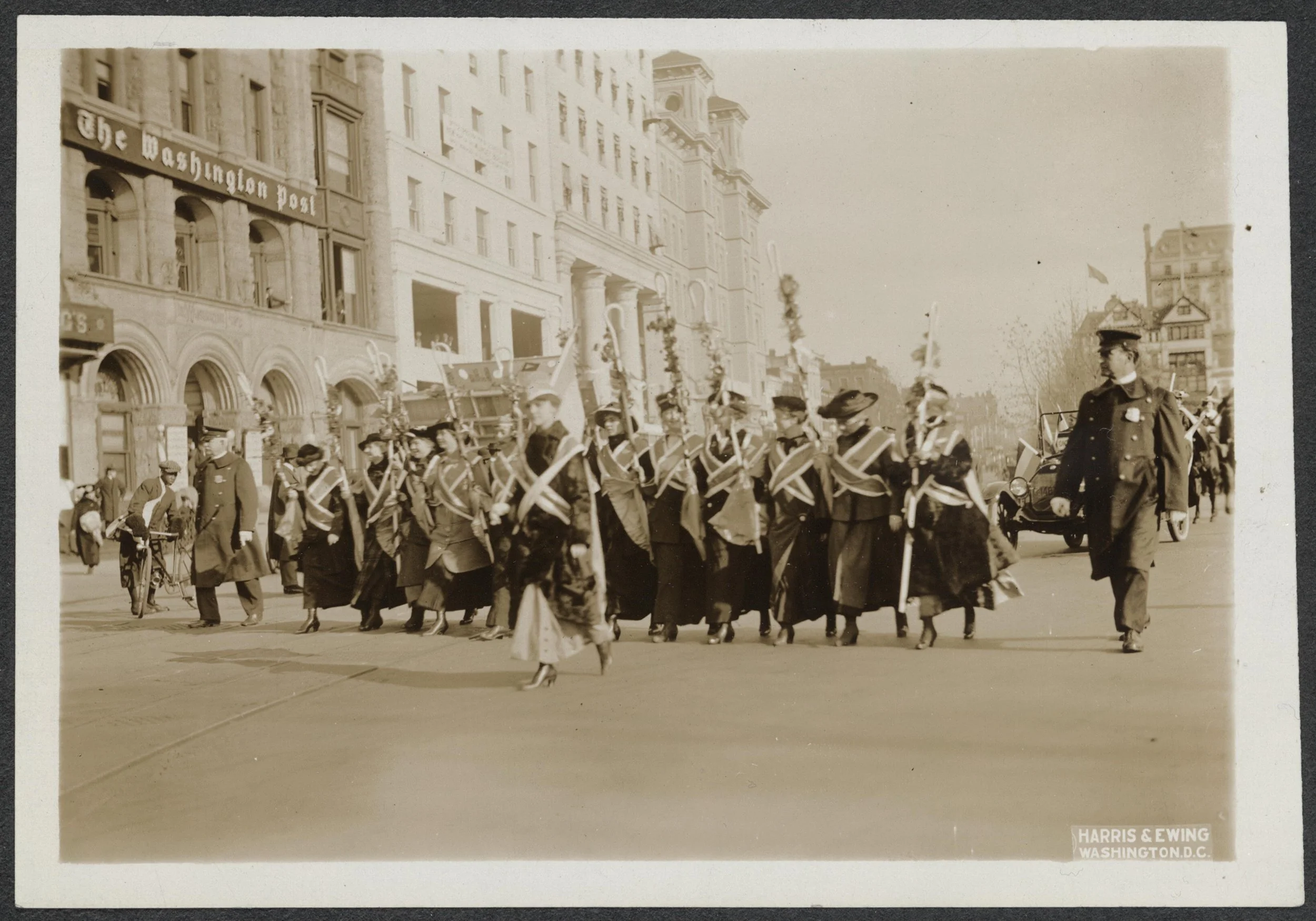
Women marching in national suffrage demonstration in Washington, D.C., May 9, 1914. | Library of Congress
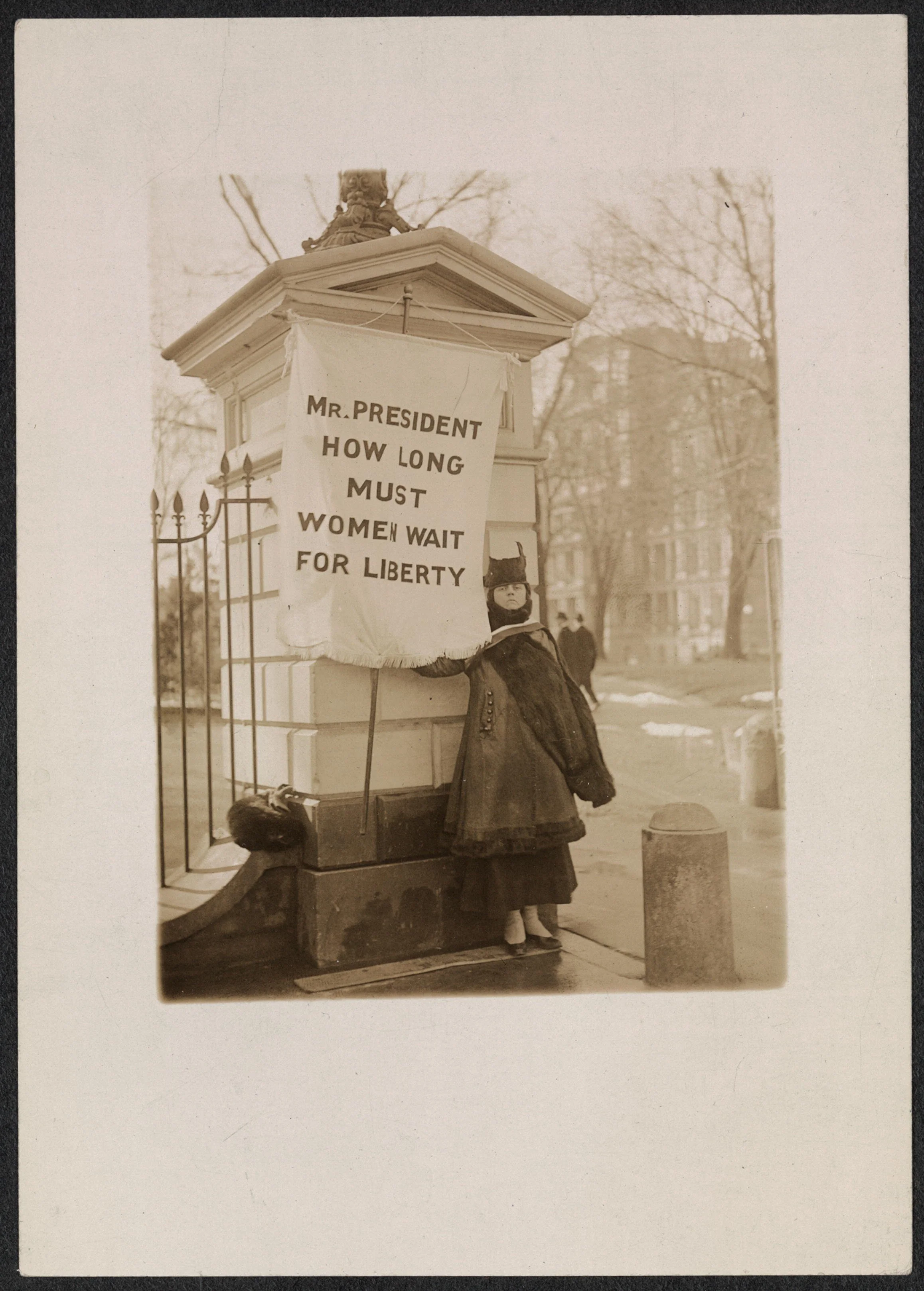
"Silent sentinel" Alison Turnbull Hopkins at the White House on New Jersey Day, January 30, 1917. | Library of Congress
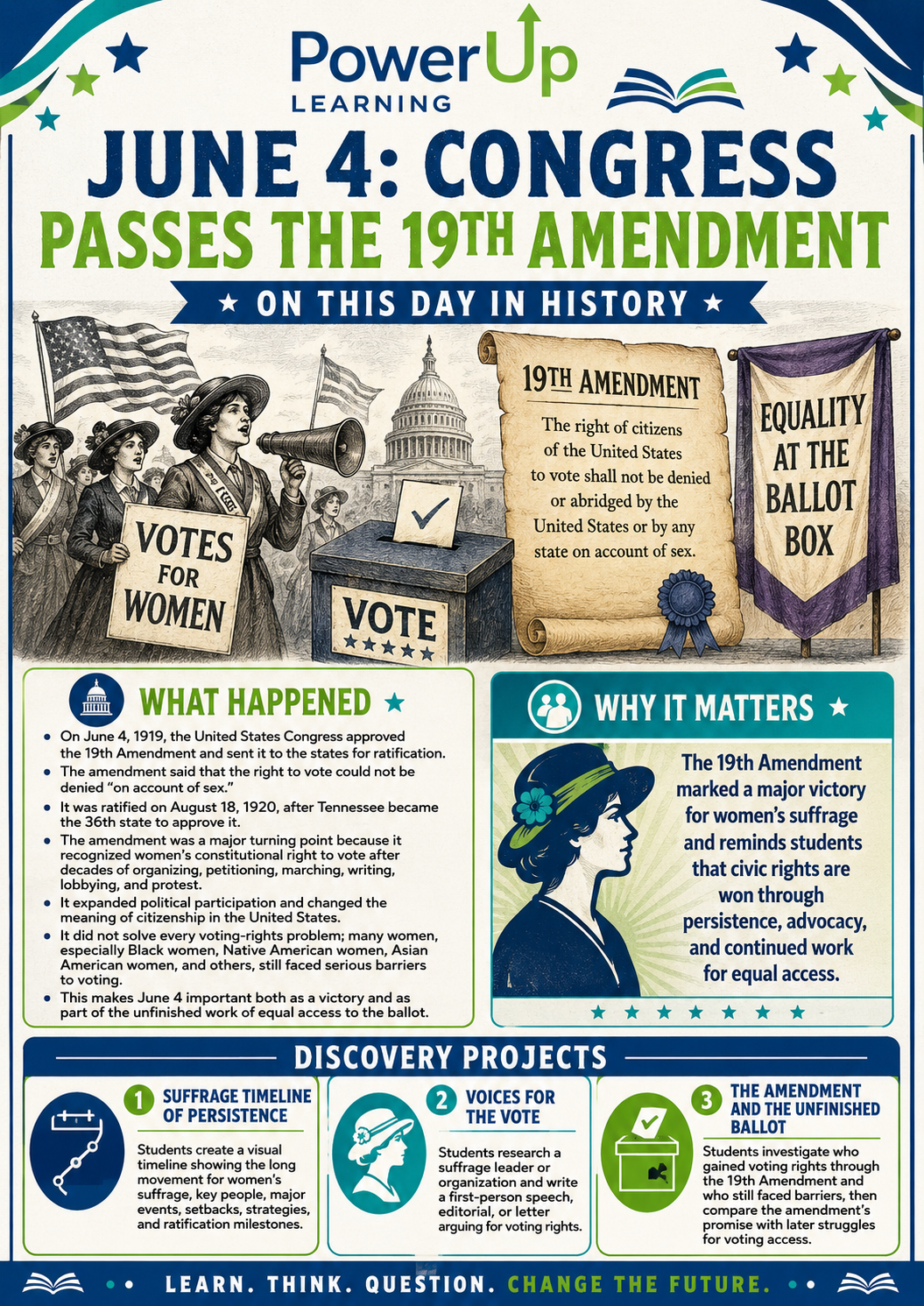
On June 4, 1919, the United States Congress approved the 19th Amendment and sent it to the states for ratification. The amendment stated that the right to vote could not be denied “on account of sex.” It was ratified on August 18, 1920, after Tennessee became the 36th state to approve it.
The history of the 19th Amendment began long before it became part of the United States Constitution. During the 1800s, many women were denied the right to vote, even though they were expected to obey laws, pay taxes, and contribute to their communities. The women’s suffrage movement grew out of broader reform efforts connected to abolition, education, property rights, and equal citizenship. In 1848, reformers gathered at the Seneca Falls Convention in New York, where leaders such as Elizabeth Cady Stanton and Lucretia Mott helped call national attention to women’s rights, including the right to vote. Over time, activists organized conventions, wrote speeches and petitions, published newspapers, and worked state by state to gain voting rights.
The movement continued through the late 1800s and early 1900s, led by many different women and organizations. Leaders such as Susan B. Anthony, Sojourner Truth, Lucy Stone, Ida B. Wells, Carrie Chapman Catt, and Alice Paul used different strategies to push for suffrage. Some worked through state campaigns and public education, while others used marches, protests, picketing, and civil disobedience. The movement was not always unified, and it also reflected racial and regional tensions of the time. Black women, including Ida B. Wells and Mary Church Terrell, fought for voting rights while also confronting racism within the suffrage movement and in American society more broadly.
One of the most dramatic moments in the ratification of the 19th Amendment took place in Tennessee in August 1920. By that time, 35 states had ratified the amendment, but 36 were needed for it to become part of the Constitution. Tennessee became the deciding state. During the vote in the Tennessee House of Representatives, young legislator Harry T. Burn was expected to oppose ratification, but he changed his vote and supported the amendment. One reason was a letter from his mother, Febb Ensminger Burn, who urged him to “be a good boy” and vote for suffrage. His vote helped Tennessee ratify the amendment on August 18, 1920, giving the nation the final state approval needed. This moment became one of the most memorable stories in the history of women’s suffrage because a mother’s advice helped influence a vote that expanded constitutional voting rights for women across the United States.
After decades of organizing, Congress passed the 19th Amendment in 1919, and it was ratified on August 18, 1920, when Tennessee became the final state needed for approval. The amendment states that the right to vote cannot be denied on account of sex. Its ratification was a major victory for women’s suffrage and expanded democracy in the United States. However, the amendment did not guarantee equal access to the ballot for all women. Many Black, Native American, Asian American, and Latina women continued to face discriminatory laws and practices that prevented them from voting. The 19th Amendment remains important because it marked a turning point in American constitutional history while also reminding us that the struggle for full voting rights continued long after 1920.
Discovery Projects
Project 1: Suffrage Timeline of Persistence
Project Goal:
Students will understand that the 19th Amendment was the result of long-term civic action rather than a single moment.
Project Description:
Students create a visual timeline beginning with early women’s rights activism and ending with the ratification of the 19th Amendment in 1920. The timeline should include major events, key people, setbacks, strategies, and state ratification milestones.
Research Questions:
What events helped build momentum for women’s suffrage?
Which leaders and organizations worked for voting rights?
Why did it take so many decades for the amendment to pass?
What happened between congressional approval on June 4, 1919, and ratification in 1920?
Final Project Options:
Illustrated poster timeline
Digital slideshow
Accordion-style booklet
Museum-style wall display
Project 2: Voices for the Vote
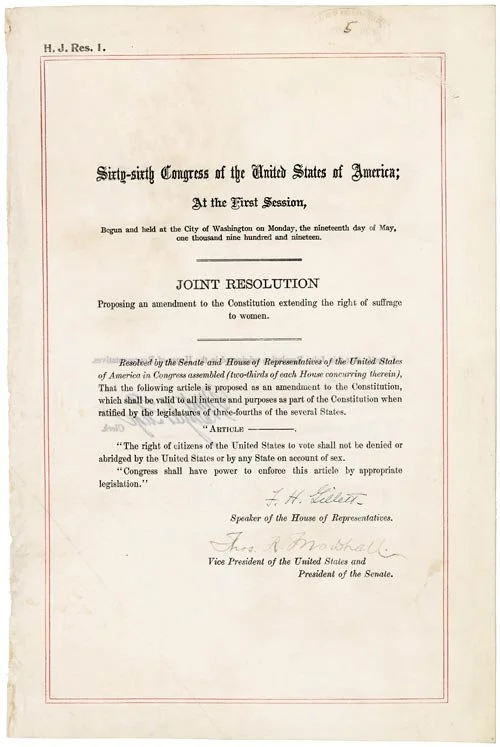
Citation: Joint Resolution of Congress proposing a constitutional amendment extending the right of suffrage to women, approved June 4, 1919.; Ratified Amendments, National Archives.
Project Goal:
Students will examine how citizens use speech, writing, and public advocacy to create political change.
Project Description:
Students research one suffrage leader or organization and write a first-person speech, newspaper editorial, or letter to a legislator arguing for the right to vote. The writing should use historical evidence and reflect the language, concerns, and civic arguments of the time.
Research Questions:
What arguments did suffragists use to support voting rights?
What arguments did opponents use against women’s suffrage?
How did suffragists use newspapers, speeches, marches, and lobbying?
How can words become tools for civic change?
Final Project Options:
Persuasive speech
Historical editorial
Letter to Congress
Recorded audio address
Dramatic classroom reading
Project 3: The Amendment and the Unfinished Ballot
Project Goal:
Students will analyze the difference between a constitutional right and equal access to that right.
Project Description:
Students investigate who gained voting rights through the 19th Amendment and who continued to face barriers. They compare the amendment’s promise with the later struggles for voting access faced by Black women, Native American women, Asian American women, and other groups.
Research Questions:
What did the 19th Amendment legally guarantee?
Why were some women still prevented from voting after 1920?
What barriers limited voting access?
How did later civil rights efforts build on the work of suffrage activists?
Additional Project Options:
Compare-and-contrast chart
Research essay
Civic rights infographic
Classroom discussion board
“Then and Now” voting rights presentation