.jpg)
John Maynard Keynes
On June 5, 1883, John Maynard Keynes was born in Cambridge, England. Keynes became one of the twentieth century’s most influential economists by challenging the belief that free markets would always recover quickly from economic downturns without government intervention. During the Great Depression, he argued that prolonged unemployment could result when households and businesses reduced spending simultaneously, causing demand, production, and employment to continue falling. His major work, The General Theory of Employment, Interest and Money, proposed that governments could respond to severe recessions by increasing public spending and supporting employment.
Keynes’s ideas were important because they changed how governments understood their responsibility during economic crises. Rather than waiting for markets to correct themselves, governments could use spending, taxation, and monetary policies to stabilize the economy and reduce unemployment. Keynesian economics influenced government responses to recessions and helped establish macroeconomics, the study of economy-wide issues such as employment, inflation, economic growth, and national production. His ideas remain influential and continue to generate debate over how much governments should intervene in the economy.
Keynes also helped shape the international financial system following World War II. As a leading British representative at the 1944 Bretton Woods Conference, he contributed to negotiations that resulted in the creation of the International Monetary Fund and the World Bank. These institutions were designed to encourage international economic cooperation, stabilize currencies, finance reconstruction, and reduce the risk that economic instability would contribute to another global conflict. Keynes’s legacy demonstrates how one person’s ideas can influence national policies, international institutions, and debates that continue long after that person’s lifetime.
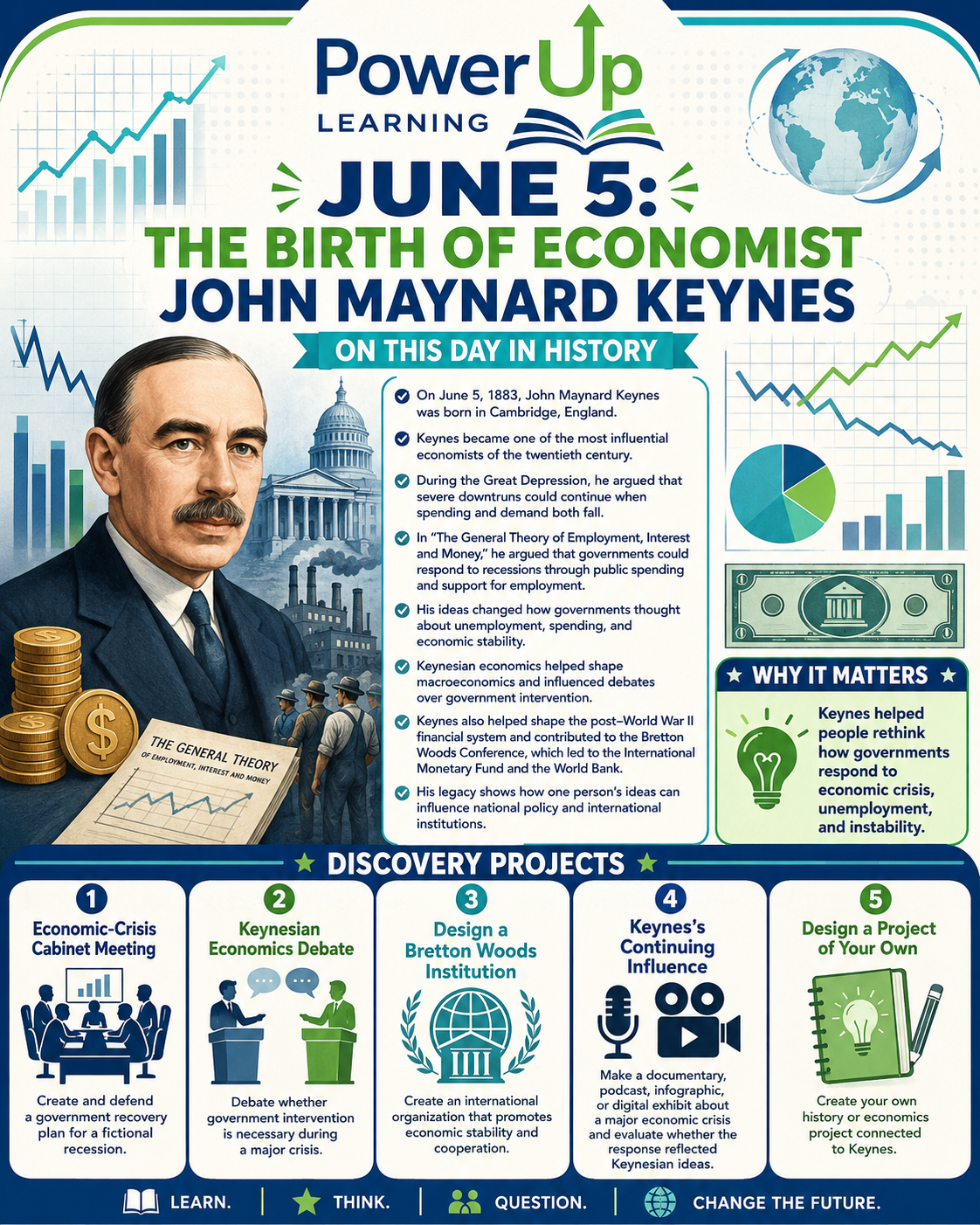
Discovery Projects
1. Economic-Crisis Cabinet Meeting
Students act as government economic advisers responding to a fictional recession involving unemployment, declining business activity, and reduced consumer spending. They must create and defend a recovery plan that explains whether the government should increase spending, lower taxes, provide direct assistance, or allow the market to recover independently.
2. Keynesian Economics Debate
Students research and debate the statement:
During a major economic crisis, government intervention is necessary to restore economic stability.
Middle school students can compare the benefits and risks of government action. High school students should incorporate Keynesian theory, competing economic perspectives, historical evidence, and possible unintended consequences.
3. Design a Bretton Woods Institution
Students design an international organization intended to prevent economic instability and promote cooperation among nations. Their proposal should explain the institution’s mission, membership rules, funding, decision-making structure, and response to countries facing financial crises.
4. Keynes’s Continuing Influence
Students create a documentary, podcast, infographic, or digital exhibit examining how governments have responded to a major economic crisis, such as the Great Depression, the 2008 financial crisis, or the economic disruption caused by COVID-19. The final project should evaluate whether the response reflected Keynesian ideas and whether the policies achieved their intended results.