May 26: Voting Rights Act of 1965
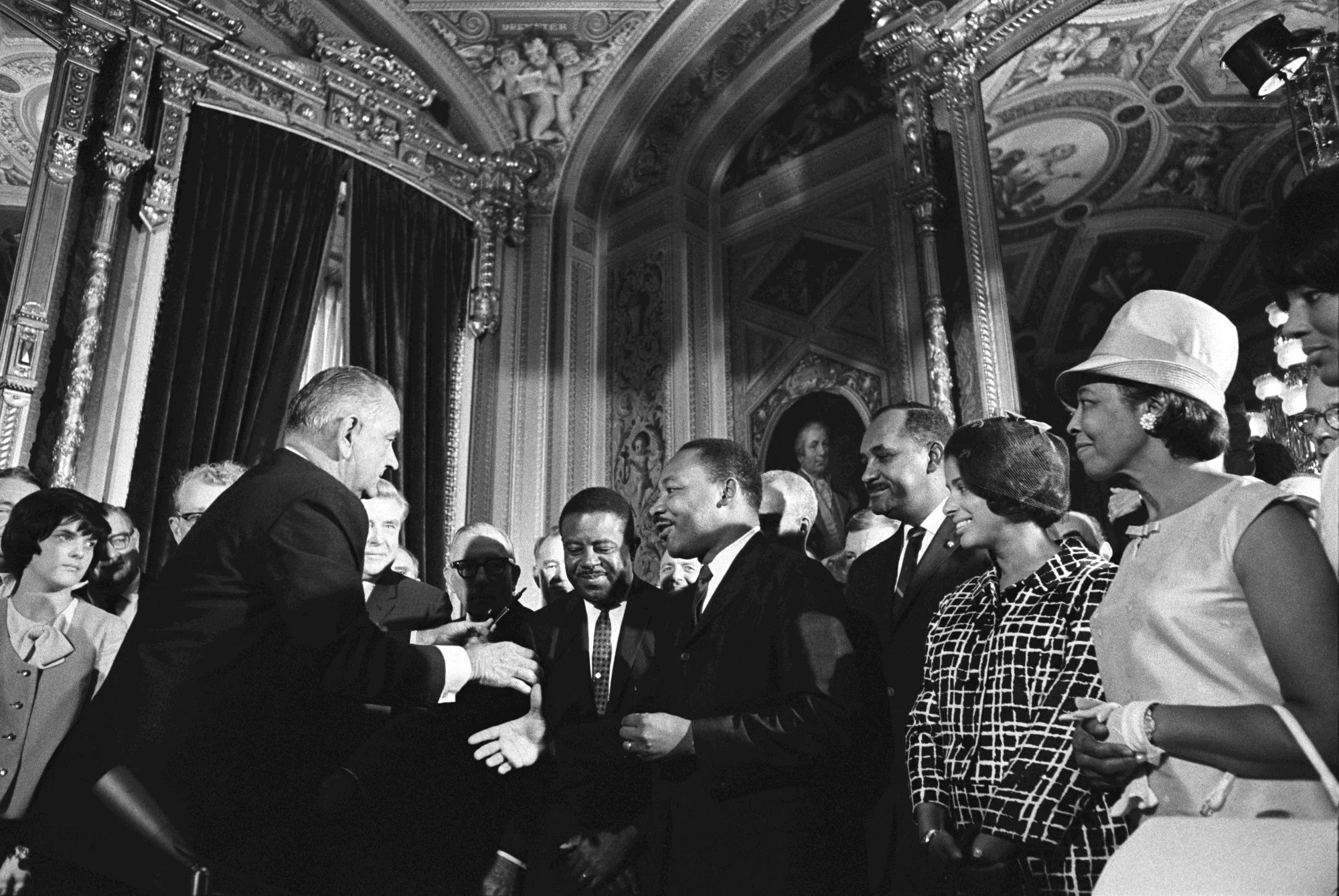
President Johnson signed the Voting Rights Act into law on August 6, 1965.
On May 26, 1965, the United States Senate passed the Voting Rights Act of 1965 by a vote of 77–19, moving one of the most important civil rights laws in American history closer to final passage. Although this event is usually remembered as a voting-rights milestone, it also connects strongly to educational history because many discriminatory voting practices were tied to unequal access to education. Literacy tests, confusing registration requirements, and unequal schooling had been used to prevent many Black citizens from exercising their constitutional rights. The Voting Rights Act helped challenge those barriers by giving the federal government stronger power to protect voting access. For students, this event is important because it shows how education, citizenship, civil rights, and democracy are connected. The ability to read, understand laws, participate in public decisions, and vote has long been shaped by who has access to fair and equal education.
Congress amended and reauthorized the Voting Rights Act of 1965 several times to keep its protections active and respond to continuing forms of voting discrimination. In 1970, Congress extended key temporary provisions, including federal oversight of certain jurisdictions. In 1975, the law was expanded to protect language minority groups, including voters who spoke Spanish, Native American languages, Asian languages, and Alaska Native languages, requiring language assistance in certain places. In 1982, Congress strengthened Section 2 by making it clear that voting practices could be challenged if they resulted in discrimination, even without proving intentional discrimination. In 1992, Congress expanded language-access provisions, helping more citizens receive ballots and voting materials in languages they could understand. In 2006, Congress reauthorized major enforcement provisions for another 25 years.
Today, the Voting Rights Act of 1965 is still federal law, but its enforcement power has been significantly reduced compared with its original form. Section 2 remains in effect nationwide and prohibits voting practices that discriminate on the basis of race, color, or membership in a language minority group; the U.S. Department of Justice describes Section 2 as permanent, with no expiration date. However, the Act’s strongest original protection, Section 5 preclearance, is largely inactive because the Supreme Court’s 2013 decision in Shelby County v. Holder struck down the Section 4(b) coverage formula that determined which states and localities had to get federal approval before changing voting laws. As a result, many voting-law changes that once would have been reviewed by the federal government before taking effect now must usually be challenged after they are enacted.
The law continues to be used in court, especially through Section 2 lawsuits involving redistricting, vote dilution, language access, and discriminatory election procedures. The Justice Department still enforces federal voting-rights laws, including the Voting Rights Act. At the same time, recent Supreme Court cases and lower-court disputes have continued to narrow or test how much protection the Act provides, especially in redistricting cases and questions about who may bring lawsuits under Section 2. Congress has considered proposals such as the John R. Lewis Voting Rights Advancement Act to restore a modern preclearance system, but no full restoration of the preclearance formula has become law. In practical terms, the Voting Rights Act still exists and still matters, but it is no longer as strong as it was before Shelby County v. Holder.
Elementary School Project: Citizenship and Voting Rights Poster
Grade Level: Elementary School
Project Focus: Understanding how voting rights connect to fairness, citizenship, and education.
Goal
Students will gain an understand of voting as an important part of integral to citizenship and that unfair laws and practices once prevented many Americans from fully participating in democracy.
Activity
Students create a Citizenship and Voting Rights Poster. The poster should include the title “Voting Rights and Fairness” and show three ideas:
Why voting matters
How literacy tests made voting harder for some citizens
How education helps people participate in civic life
Students should include drawings, symbols, short captions, and a three- to five-sentence explanation at the bottom of the poster.
Outcome
Students will create a visual project that explains the connection between education, fairness, and voting rights. Students should be able to describe why the Voting Rights Act of 1965 was important and how reading, learning, and civic knowledge help people participate in democracy.
Middle School Project: Literacy Test Primary Source Analysis
Grade Level: Middle School
Project Focus: Analyzing how literacy tests were used as barriers to voting.
Goal
Students will analyze how literacy tests were used to deny voting rights and explain why equal access to education and voting are connected.
Activity
Students examine a sample historical literacy test or a short description of literacy test requirements used before the Voting Rights Act. They should design a chart that addresses the following questions.
What was the purpose of the literacy test?
Who was most affected by it?
Why was the test unfair?
How did the Voting Rights Act respond to this problem?
After completing the chart, students write a one-page response answering this question:
How did literacy tests impact voting rights in American history?
Outcome
Students will produce a completed analysis chart and a written response using evidence. Students should be able to explain that literacy tests were not simply reading assessments; they were often tools used to block citizens, especially Black citizens, from voting.
High School Project: Voting Rights Act Civic Argument Essay
Grade Level: High School
Project Focus: Evaluating the relationship between education, citizenship, and civil rights.
Common Core State Standards Addressed
CCSS.ELA-LITERACY.RH.9-10.1
Students cite specific textual evidence to support analysis of primary and secondary sources, attending to features such as date and origin.
CCSS.ELA-LITERACY.RH.9-10.9
Students compare and contrast treatments of the same topic in several primary and secondary sources.
CCSS.ELA-LITERACY.WHST.9-10.1
Students write arguments focused on discipline-specific content.
CCSS.ELA-LITERACY.WHST.9-10.9
Students draw evidence from informational texts to support analysis, reflection, and research.
Goal
Students will evaluate how the Voting Rights Act of 1965 addressed barriers to democratic participation and how literacy affected citizens’ ability to understand and exercise their rights.
Activity
Students write a two- to three-page civic argument essay responding to this prompt:
How did the Voting Rights Act of 1965 show the connection between literacy, citizenship, and civil rights?
The essay should include:
A clear thesis statement
Historical background on voting barriers before 1965
An explanation of how literacy tests and unequal schooling affected voting access
Evidence from at least two sources
A conclusion explaining why civic education remains important today
Outcome
Students will produce a structured argument essay supported by historical evidence. Students should be able to explain that the Voting Rights Act was not only about voting procedures; it also reflected larger struggles over education, equality, citizenship, and full participation in American democracy.